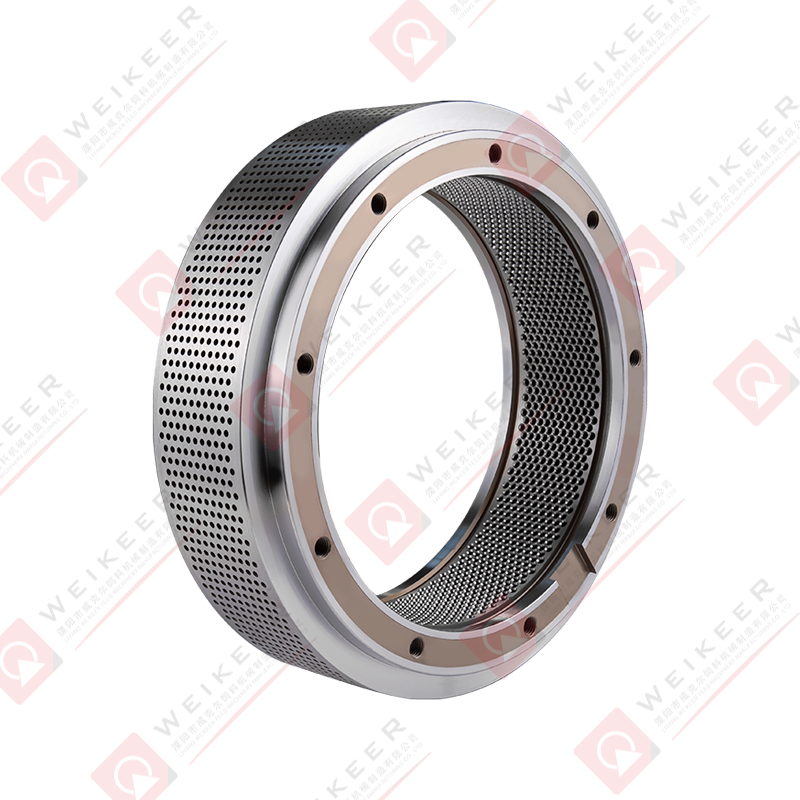
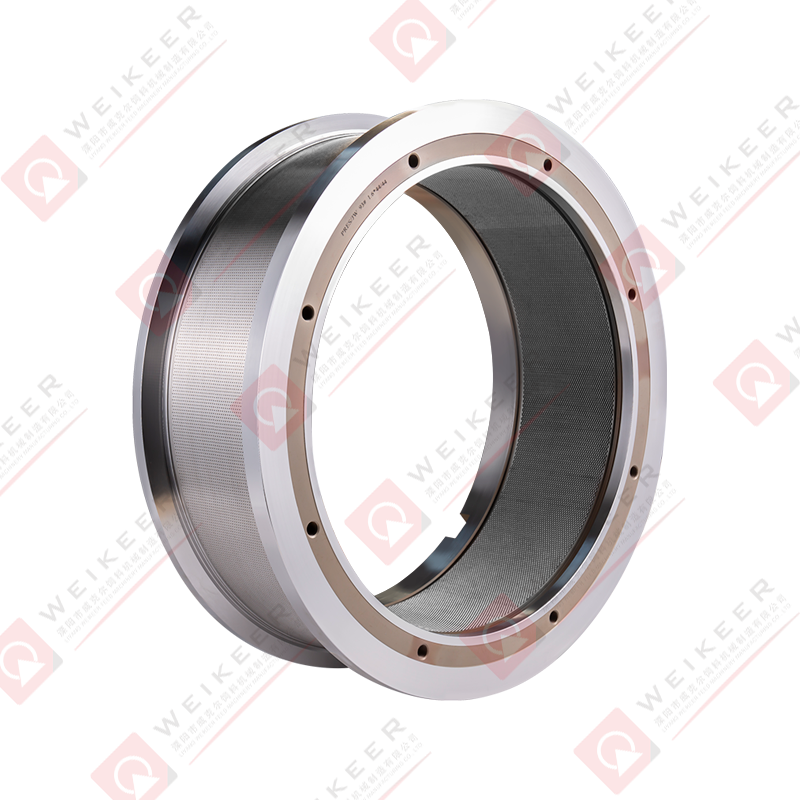
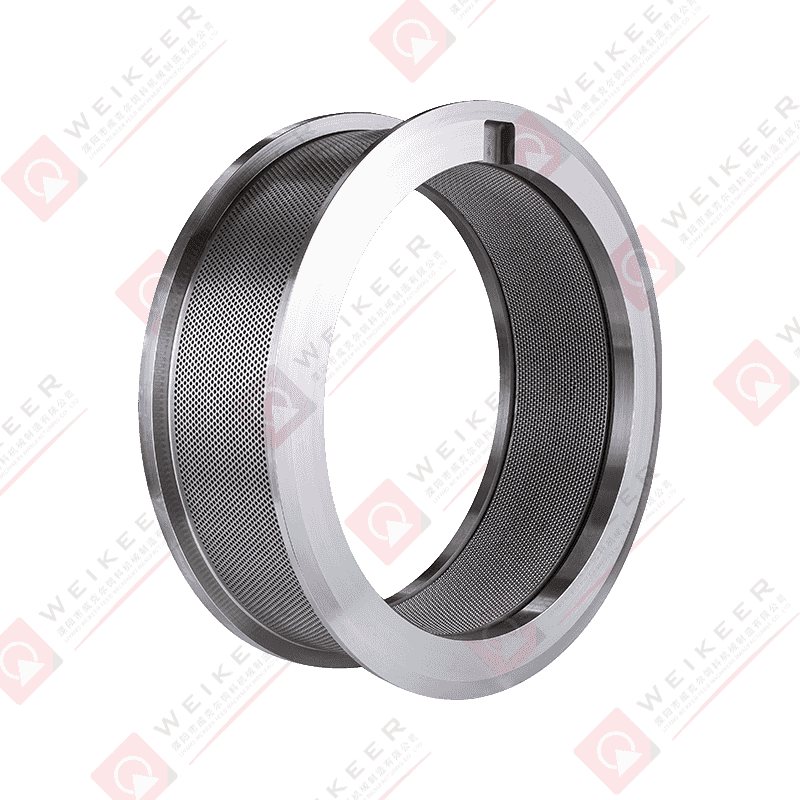
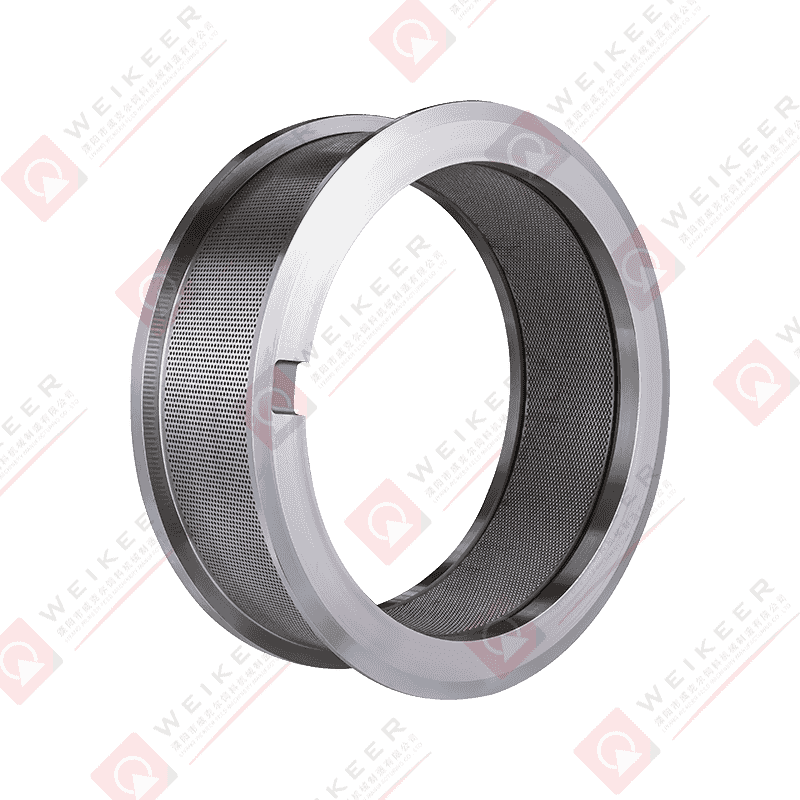
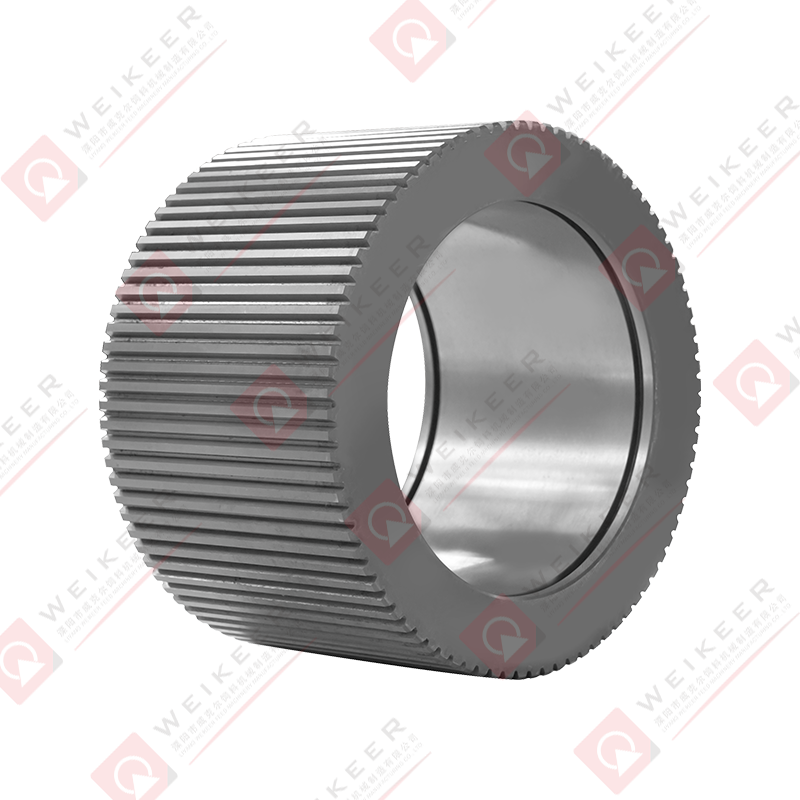
Pellet mill rollers operate under some of the harshest mechanical conditions found in any continuous industrial process. They press raw biomass, animal feed, wood fiber, or other compressible materials through a die under compressive and frictional loads, cycle after cycle, often running 20 or more hours per day. The material from which these rollers are manufactured is not a secondary consideration — it is one of the primary determinants of roller service life, maintenance intervals, and the overall cost per ton of pellets produced. Among the materials used in high-performance pellet mill rollers, 100Cr6 spring steel has emerged as a preferred choice for shell fabrication in demanding applications where conventional engineering steels fall short. This article examines what 100Cr6 is, why its properties suit pellet mill roller service, and what buyers and maintenance engineers need to know when evaluating or replacing rollers made from this material.
What Is 100Cr6 Steel and What Makes It Different?
100Cr6 is a high-carbon, chromium-alloyed bearing steel standardized under the European EN ISO 683-17 designation and widely known internationally by equivalent designations including SAE 52100 (USA), SUJ2 (Japan), ShKh15 (Russia), and GCr15 (China). The name encodes its nominal composition: approximately 1.0% carbon (the "100" in the designation, expressed as tenths of a percent) and approximately 1.5% chromium (the "Cr6" indicating roughly 6 units of 0.25% chromium increments). Despite the designation "spring steel" being sometimes applied to this grade in commercial contexts — particularly in Eastern European and Chinese industrial supply chains — 100Cr6 is more precisely a through-hardening bearing steel rather than a traditional spring steel such as 51CrV4 or 60Si2Mn. Its application to pellet mill rollers exploits its bearing-grade properties rather than spring-specific resilience.
The key characteristics that differentiate 100Cr6 from standard carbon steels and even many alloy steels used in wear-part applications are its exceptional cleanliness (very low inclusion content), fine carbide distribution, and the combination of very high hardness after heat treatment with sufficient fracture toughness to survive impact loads in service. These properties were developed specifically for rolling element bearing manufacture — the demanding rolling contact fatigue application in mechanical engineering — which is precisely the type of stress regime that pellet mill roller shells experience during operation.
Mechanical Properties of 100Cr6 Relevant to Roller Performance
The performance of a pellet mill roller shell made from 100Cr6 is directly determined by the mechanical properties achieved through proper heat treatment. In the fully hardened and tempered condition, 100Cr6 achieves the following property ranges that are directly relevant to roller service life:
| Property |
Typical Value (Hardened & Tempered) |
Relevance to Pellet Mill Service |
| Surface hardness |
58–65 HRC |
Resists abrasive wear from die contact and feed material |
| Core hardness |
58–62 HRC (through-hardened) |
Uniform hardness resists sub-surface fatigue cracking |
| Tensile strength |
2,000–2,300 MPa |
Supports compressive loads during pelleting without deformation |
| Rolling contact fatigue life |
Very high (bearing-grade cleanliness) |
Extended shell service life before spalling or pitting failure |
| Wear resistance |
Excellent (fine carbide distribution) |
Maintains shell groove geometry over extended operating periods |
| Fracture toughness |
Moderate (adequate for pellet mill impact loads) |
Resists cracking from foreign material ingestion and overloads |
The through-hardening characteristic of 100Cr6 is particularly significant for pellet mill roller shells. Unlike case-hardened steels — where only the surface layer is hardened to depth of 1–3 mm while the core remains relatively soft — 100Cr6 achieves uniform high hardness throughout the shell cross-section. This means that as the shell surface wears during service, the material immediately beneath is equally hard and wear-resistant, maintaining consistent performance throughout the usable shell thickness rather than exhibiting accelerated wear once the hardened case is breached.
Why 100Cr6 Outperforms Common Alternatives in Pellet Mill Roller Shells
Pellet mill roller shells have historically been manufactured from a range of materials, including medium-carbon steels such as 42CrMo4, tool steels, and cast alloy irons. Each has advantages in certain contexts, but 100Cr6 offers a combination of properties that makes it technically for the specific stress mode that roller shells experience in a ring-die pellet mill.
Comparison with 42CrMo4 (SCM440)
42CrMo4 is a widely used chromium-molybdenum alloy steel that, when heat-treated, achieves tensile strengths of 1,000–1,200 MPa and hardness values of approximately 30–38 HRC in the quenched and tempered condition. While this is adequate for many structural and mechanical components, the hardness is significantly lower than 100Cr6 in the fully hardened state. In abrasive pelleting service — particularly biomass with high silica content or mineral-supplemented animal feed — roller shells made from 42CrMo4 wear significantly faster than 100Cr6 shells, requiring more frequent replacement and generating higher maintenance costs per operating hour. The trade-off is that 42CrMo4 is tougher and less brittle, making it more tolerant of severe impact loads or foreign material ingestion events that could chip or crack a harder 100Cr6 shell.
Comparison with Cast Alloy Iron
Cast alloy iron roller shells — including high-chromium white iron compositions — offer abrasion resistance due to the presence of hard carbide phases distributed through the matrix. However, cast irons have significantly lower tensile strength and fracture toughness than 100Cr6, making them susceptible to catastrophic cracking when subjected to the bending and impact loads that occur during foreign material ingestion, startup surges, or off-center loading. The manufacturing variability inherent in casting processes also means that carbide distribution and hardness uniformity are more difficult to control than in wrought and heat-treated 100Cr6 bar or tube stock. For applications where dimensional consistency and predictable service life are important, wrought 100Cr6 is generally preferred over cast alternatives.
Heat Treatment Requirements for Pellet Mill Roller Applications
The properties of 100Cr6 described above are only realized when the material is correctly heat-treated. For pellet mill roller shell applications, the standard heat treatment sequence involves austenitizing at 840–860°C, oil quenching to achieve a martensitic microstructure, and low-temperature tempering at 150–180°C to relieve quench stresses while retaining hardness. This process requires precise temperature control and uniform heating to avoid quench cracking — a particular risk in components with varying cross-sections such as roller shells with grooved or corrugated outer surfaces.
Some manufacturers apply a cryogenic treatment (subzero treatment) after quenching, cooling the component to −70°C to −196°C before tempering. This additional step converts retained austenite — a softer phase that can form during quenching — to martensite, further improving hardness uniformity, dimensional stability, and wear resistance. Cryogenically treated 100Cr6 roller shells command a premium but can offer measurably longer service life in demanding applications where even minor variations in hardness have tangible effects on wear rate.
Buyers sourcing roller shells should request hardness test certificates documenting surface and core hardness measurements taken from actual production components, not just from test bars processed alongside the components. Hardness gradients, case depth measurements (where surface treatments are applied), and microstructural certification — confirming the absence of excessive retained austenite or non-martensitic transformation products — are all meaningful quality indicators that reputable manufacturers should be able to provide.
Shell Surface Geometry: Grooves, Corrugations, and Their Interaction with Material Properties
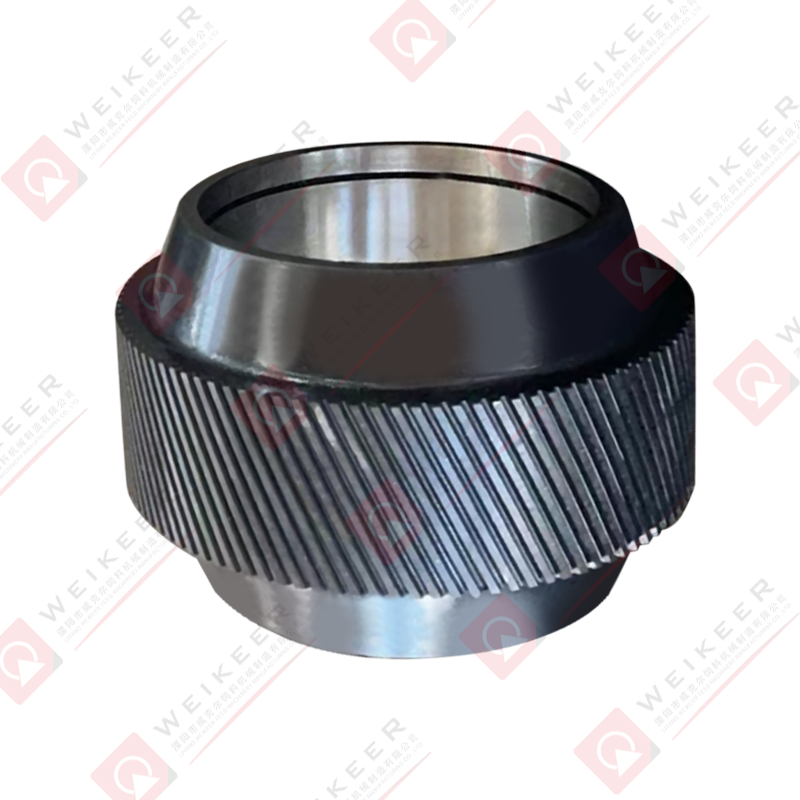
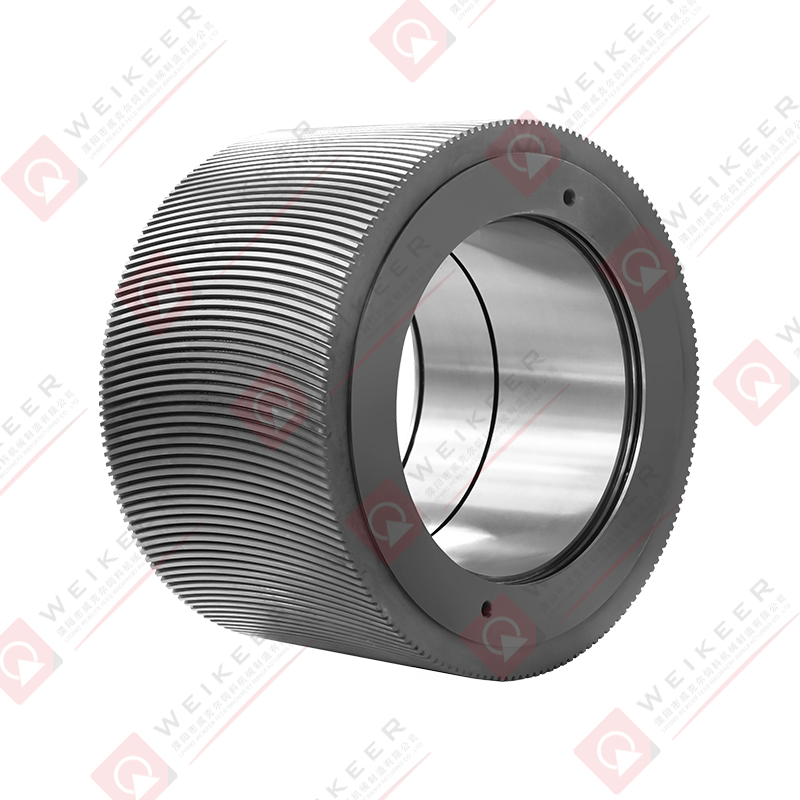
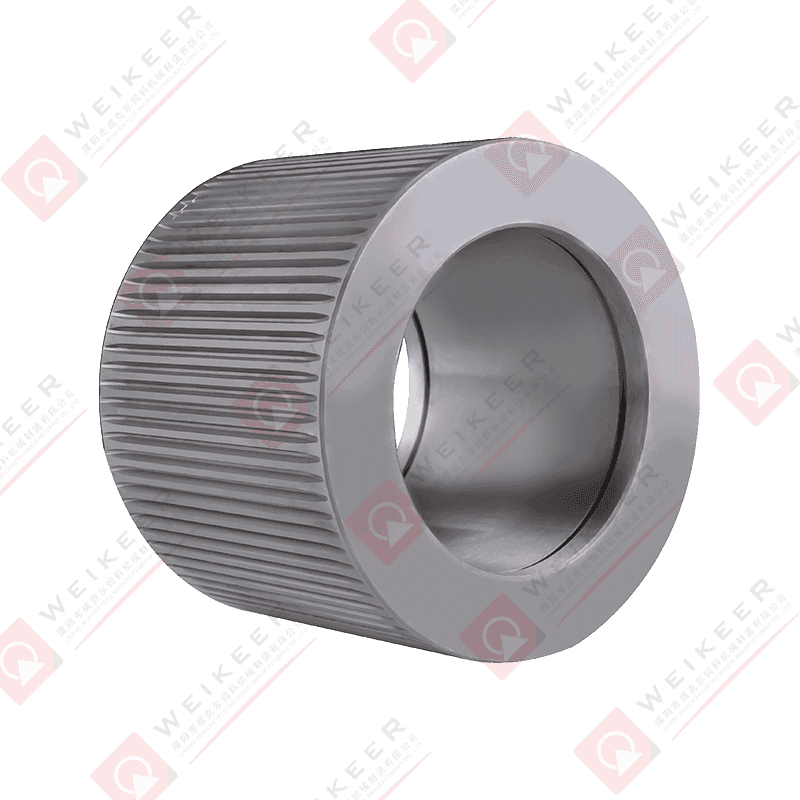
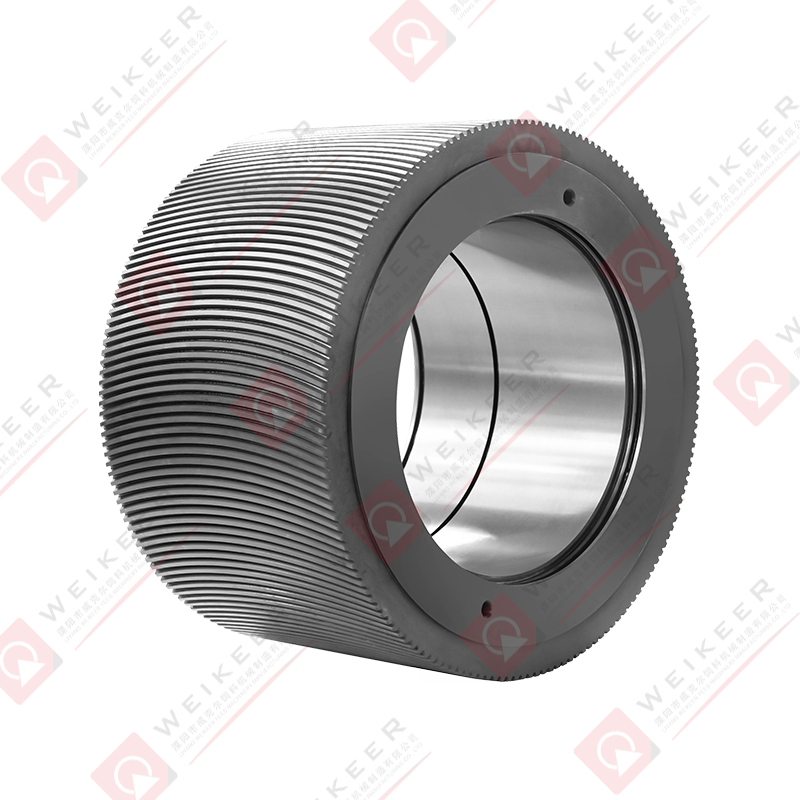
The outer surface of a pellet mill roller shell is not smooth — it is machined with a specific groove or corrugation pattern that grips the feed material and pulls it into the die holes. Common surface profiles include open groove (straight or angled), corrugated (waffle or diamond pattern), and smooth (used for certain specialty pelleting applications). The choice of surface profile affects not only the pelleting performance but also the stress concentration on the shell surface and the wear mechanism that dominates service life.
For 100Cr6 roller shells, deeper or more aggressive groove profiles increase the notch effect on the shell surface, concentrating stress at groove roots during the compression cycle. The high hardness of 100Cr6 reduces the material's ability to accommodate this stress through plastic deformation — unlike softer steels, it cannot "yield" locally to redistribute stress. This means that groove geometry must be carefully designed to avoid stress concentrations that could initiate fatigue cracks in the high-hardness material. Manufacturers experienced with 100Cr6 roller shells typically specify groove root radii, depth-to-width ratios, and surface finish requirements tailored to the material's toughness characteristics, rather than simply copying groove profiles developed for softer shell materials.
Practical Guidance for Sourcing and Replacing 100Cr6 Pellet Mill Rollers
When sourcing replacement roller shells or complete roller assemblies in 100Cr6, several practical factors distinguish high-quality components from lower-cost alternatives that may not deliver the expected service life:
- Material traceability: Reputable suppliers should provide mill certificates for the 100Cr6 bar or tube stock used in roller fabrication, confirming chemical composition compliance with EN ISO 683-17 or the applicable national standard. Unlabeled or untraced steel is a significant quality risk in a high-stress application.
- Dimensional tolerances: Roller shell bore diameter, outer diameter, and width tolerances directly affect the fit on the roller hub and the gap between roller and die. Request dimensional inspection reports or confirm that components are manufactured to OEM-equivalent tolerances for your specific pellet mill model.
- Hardness uniformity: Spot-check hardness at multiple circumferential and axial positions on the shell surface and, where possible, at cross-sections from sample components. Hardness variation greater than ±2 HRC across a single shell indicates inconsistent heat treatment that will produce uneven wear in service.
- Surface finish of bore and end faces: The bore surface finish affects the fit and fretting behavior between shell and hub. A poorly finished bore can to fretting corrosion that loosens the shell-hub interface and accelerates overall roller assembly wear beyond the shell material's intrinsic capabilities.
- Matched die and roller procurement: The die and roller shell wear as a matched pair. Installing new 100Cr6 roller shells against a worn die — or vice versa — results in accelerated break-in wear and reduced service life for both components. Whenever possible, replace die and roller shells as a set and allow adequate break-in time at reduced load before returning to full production throughput.
Maintenance Practices That Protect 100Cr6 Roller Shells
Even the roller shell material will underperform if maintenance practices are inadequate. For 100Cr6 shells specifically, the high hardness that provides wear resistance also means that impact damage from foreign material — stones, metal fragments, or tramp material — can cause localized chipping or spalling that initiates premature shell failure. Effective magnetic separation and screening of incoming feed material before it reaches the pellet mill is therefore essential protective maintenance, not optional. Many operators who report unexpectedly short roller shell life are experiencing impact damage rather than normal abrasive wear, and upgrading the feed cleaning system resolves the problem more cost-effectively than switching to a tougher (but less wear-resistant) shell material.
Bearing lubrication within the roller assembly is the other critical maintenance factor. Pellet mill rollers operate in a contaminated, high-temperature environment where standard relubrication intervals are often insufficient. Under-lubricated roller bearings generate heat that is conducted into the roller shell, which can soften the 100Cr6 material if temperatures consistently exceed the original tempering temperature — typically 150–180°C for bearing-grade 100Cr6. Monitoring roller temperature during operation, following manufacturer-specified lubrication intervals, and using the correct grease specification for the operating temperature are straightforward practices that directly protect the material properties that make 100Cr6 roller shells worth the investment.



 русский
 Español
 عربى
عربى 中文简体
中文简体