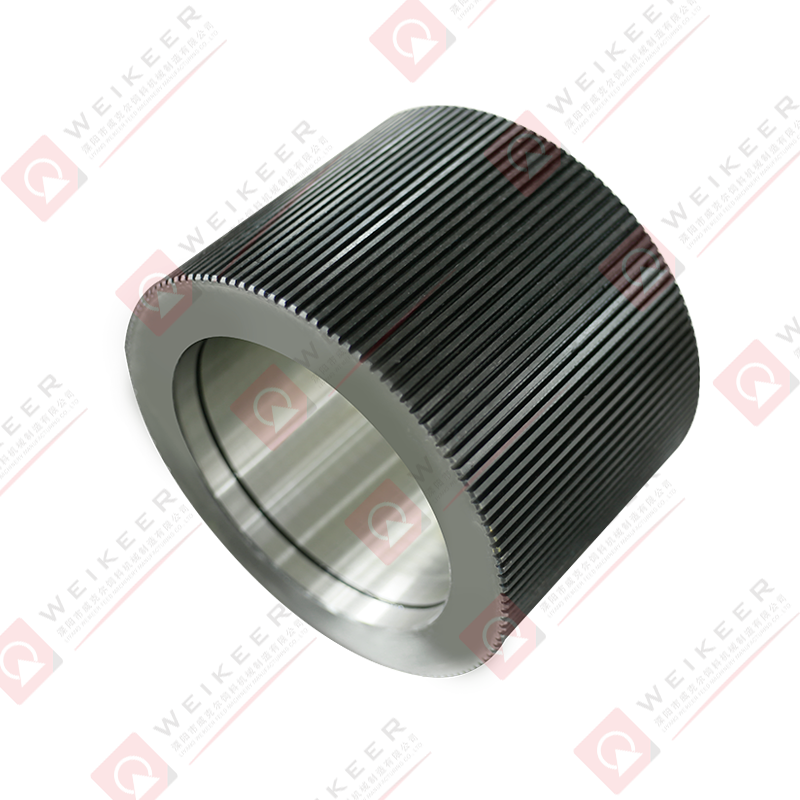
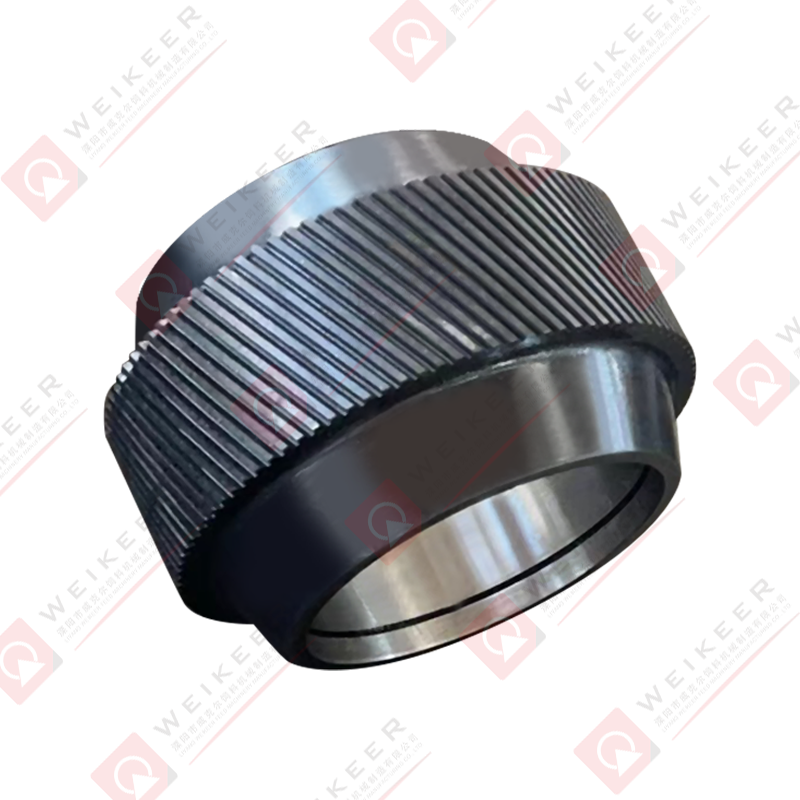
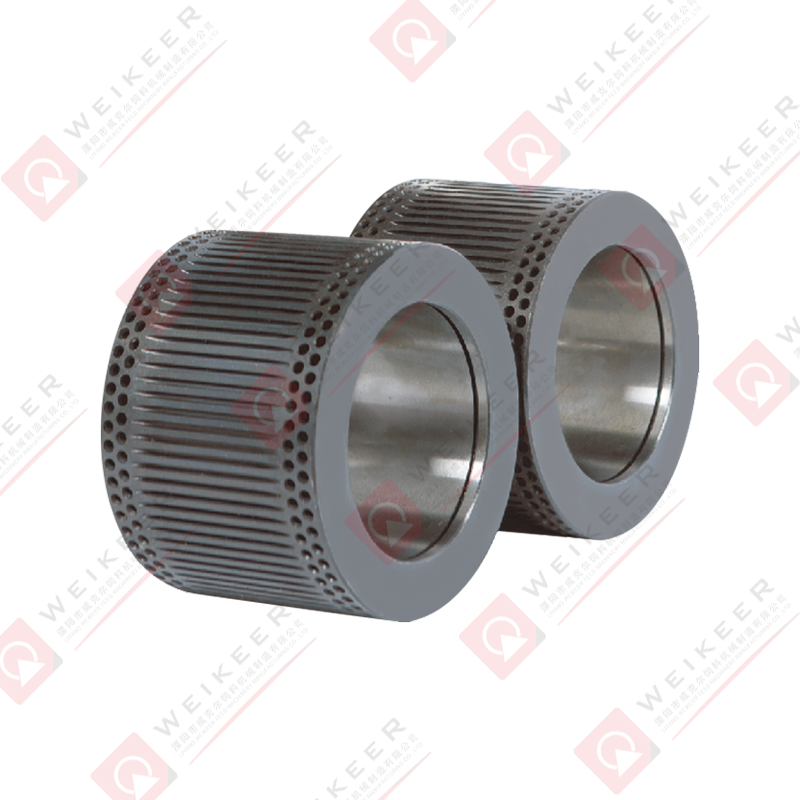
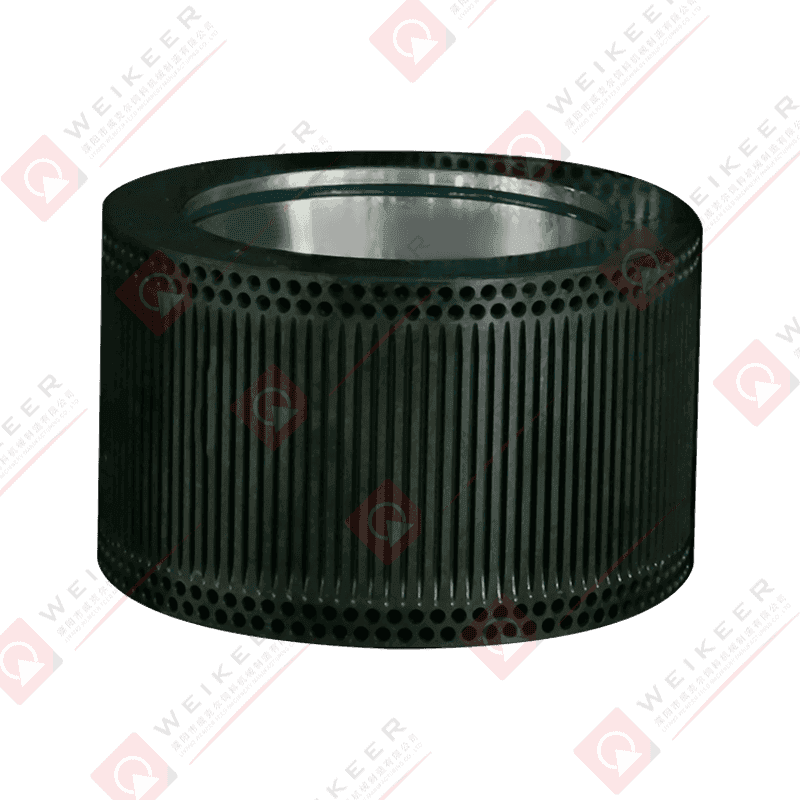
Ask any aqua feed producer which part spoils a production week, and you will usually hear the same answer: a die that blocks, pellets that break up in water, or a changeover that swallows an entire shift. The ring die sits at the centre of all three. As a screw type ring die factory, we have been building these parts since 1996 for feed mills that cannot afford that kind of week.
Liyang Weikeer Feed Machinery Manufacturing Co., Ltd. is based in Liyang, Jiangsu Province, close to Tianmu Lake, on a 13,000 square meter site with more than 7,000 square meters of workshop space. We manufacture ring dies, press rollers and related wear parts, and we supply feed mills in more than 200 export markets. This guide explains what a screw type ring die really is, how it is made, and how to choose one for aqua feed without paying for specification you will never use.
What "Screw Type" Means on an Aqua Feed Ring Die
Every ring die does two jobs at once: it forms the pellet, and it stays locked to the die holder while doing it. The second job is where the mounting structure matters, and it is the reason our stainless steel ring dies are divided into two families rather than one.
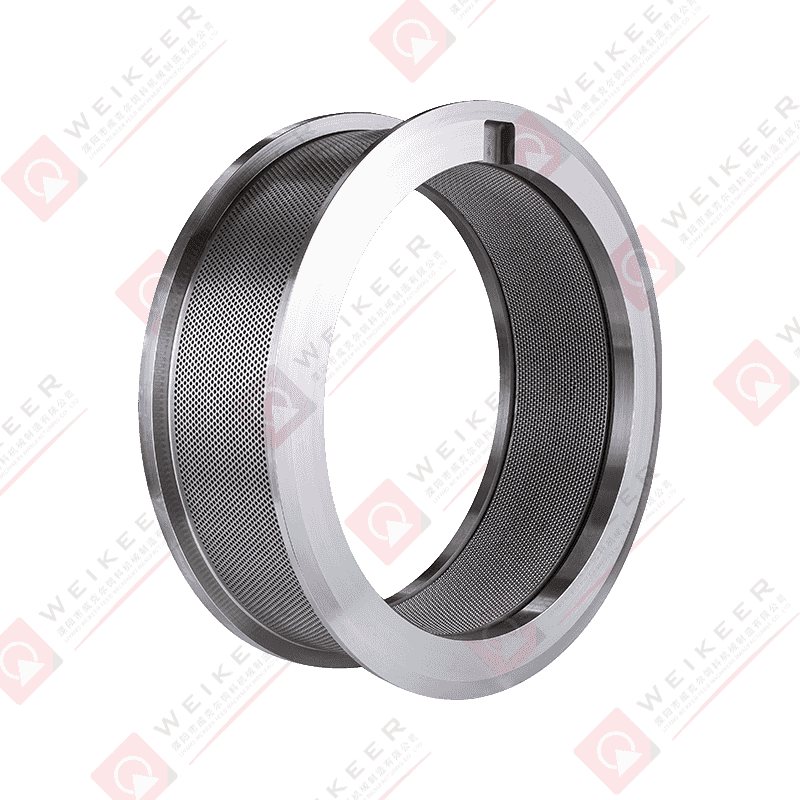
- Anchorear stainless steel die - an anchor-style fixing, used across aqua feed, livestock and poultry feed, cat litter and complex fertilizer.
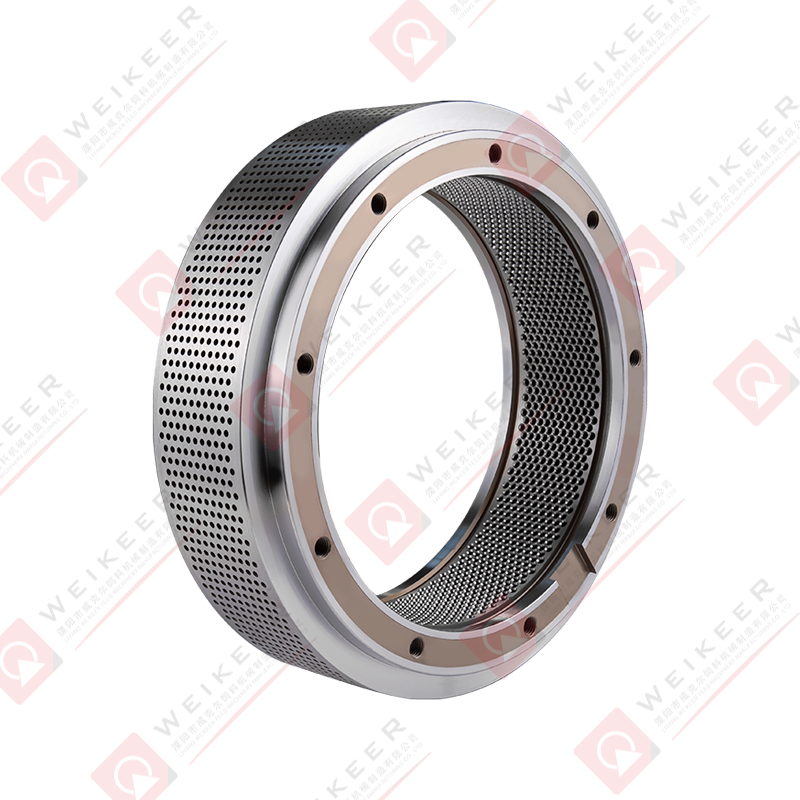
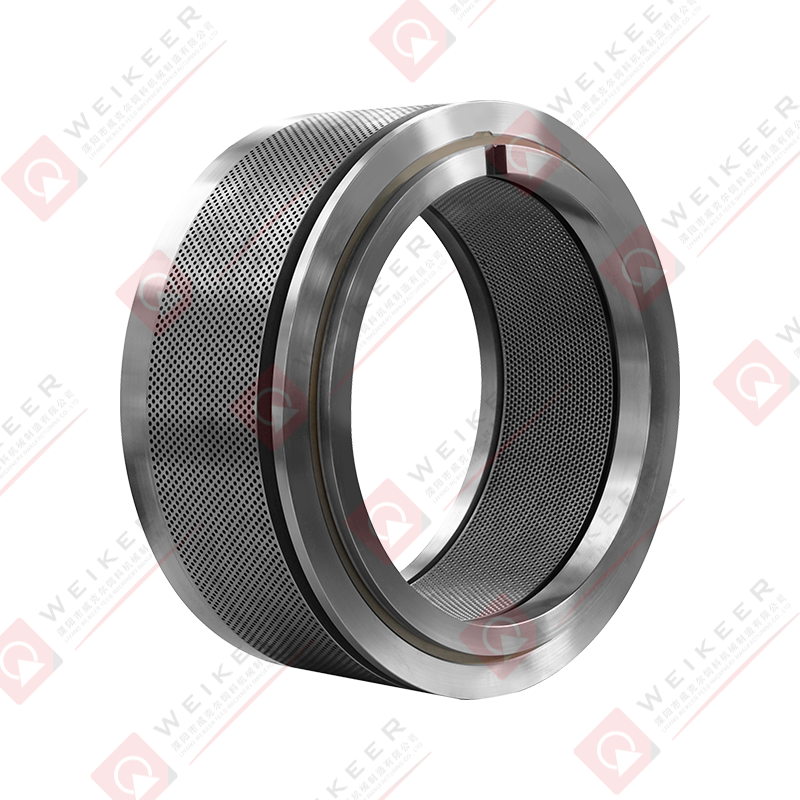
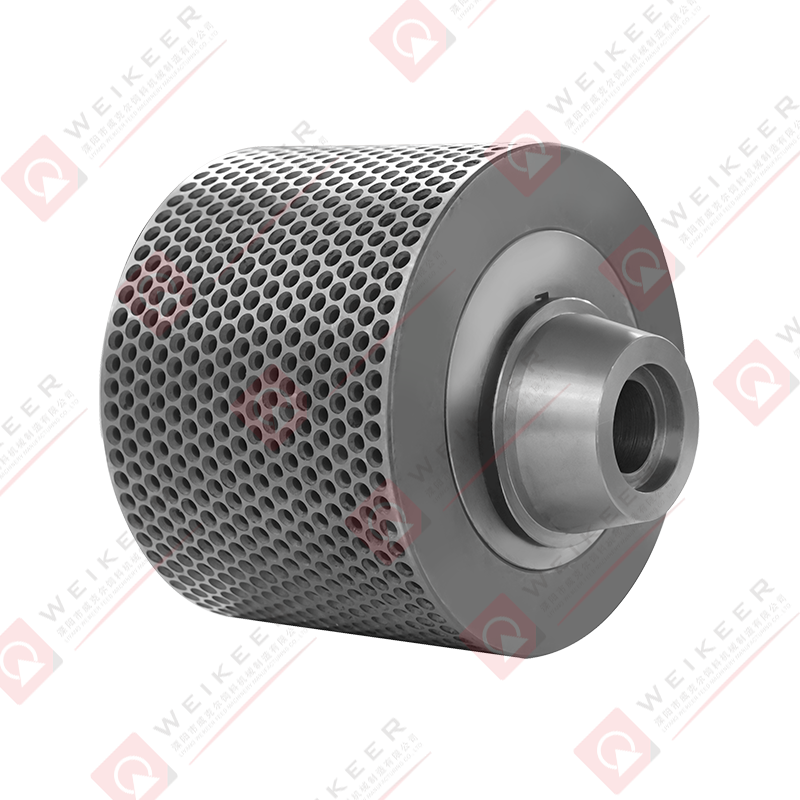
- Screw type stainless steel die - held by a ring of screws around the die body, used for aqua feed, livestock and poultry feed, and biomass pellets.
Both families are made from stainless steel rather than carbon steel, because moisture, salt and marine ingredients punish an unprotected die face. The difference lies in the clamping. Screws distributed around the circumference spread the clamping load evenly instead of concentrating it at a few points. On a small-hole aqua feed die, where back pressure across the face is high, that even load keeps the die seated and reduces movement between die and holder.
Screw fastening also helps your maintenance team. A planned die change becomes a sequence of screws instead of a fight with seized anchors, which matters when a mill runs long campaigns.
You can review the full screw type stainless steel ring die series in our catalogue, organised by application.
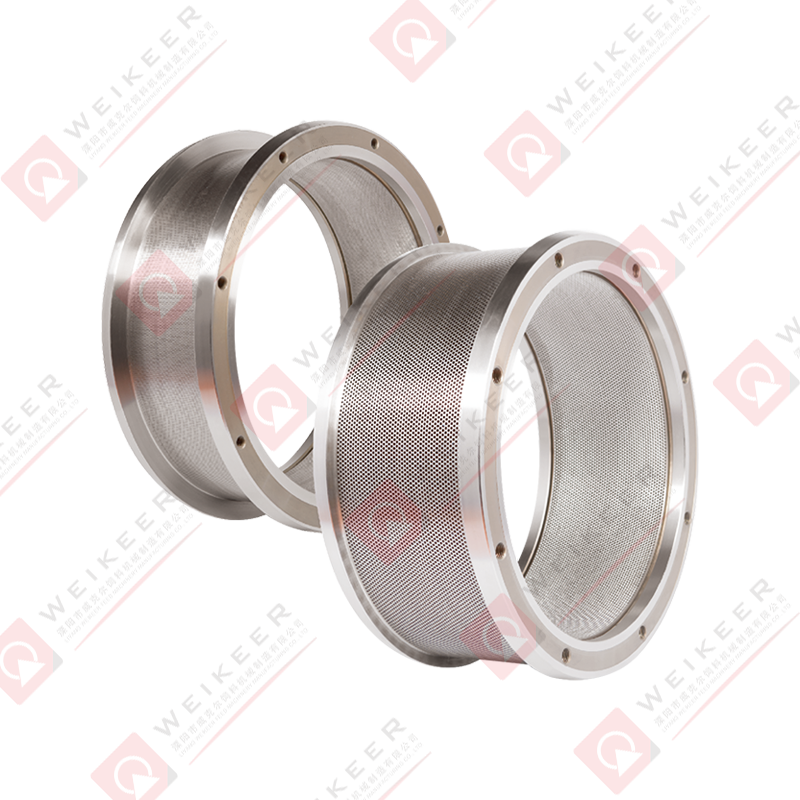 Aqua Feed Pellet Mill Screw Type Ring DieThe Screw Type Pellet Ring Die for aqua feed production is a vital component in pelletizing systems used to convert various raw ingredients into high-quality pellets d...View Product →
Why Aqua Feed Is Harder on a Die Than Poultry Feed
Aqua feed is not poultry mash, and treating it as if it were is the quickest way to short die life.
- Fine grinding and high fat. Aqua feed is ground fine and often carries added oil. Less friction sounds helpful until you remember that oil also weakens the bond between particles, so density has to come from die geometry and conditioning rather than raw pressure.
- Very small holes. Shrimp and fry feeds run from roughly 1.5 mm upward. As hole diameter falls, resistance to flow climbs steeply, and temperature, motor load and wear climb with it.
- Abrasive, corrosive ingredients. Fishmeal, squid meal, shell material, mineral premixes, salt and residual moisture attack both the hole surface and the die face.
- Water stability. A pellet that holds together in the bag but disintegrates in the pond is a complaint waiting to happen, so durability under water has to be designed into the die, not inspected afterwards.
The result is a part that must hold precise hole geometry for a long time, under high load, in a wet and mildly corrosive environment. That is a material and process question, not simply a hole-size question.
The Parameters That Decide Aqua Feed Pellet Quality
When a mill asks us for a die, the conversation is never about one number. These six parameters interact, and moving one usually forces a change in another.
Six die parameters that decide how an aqua feed pellet behaves in the pond and how long the die survives.
| Parameter |
What it controls |
What to watch in aqua feed |
| Hole diameter |
Pellet size and flow resistance |
Start from the smallest pellet your line must run; smaller holes need more open area to keep motor load sane. |
| Effective compression ratio |
Density, durability and heat build-up |
Aqua feed sits in a moderate band: too high blocks the die, too low gives pellets that fall apart in water. |
| Open area |
Throughput and load per unit of die face |
More holes lower pressure, but thin land between holes wears and cracks faster. |
| Hole entry shape |
How easily mash finds the hole |
A counterbored or tapered entry helps on fine, oily aqua feed mashes. |
| Steel grade and hardness |
Wear life against abrasives |
Hardness must be balanced with toughness: a die that is too hard cracks instead of wearing. |
| Working surface |
Even roller contact across the face |
Uneven relief shows up as bell-mouthing at the edges long before the die is worn out. |
We would rather set these values against your formula, your target capacity and your drive than sell you a stock specification that happens to be on the shelf.
From Billet to Finished Die: Inside the Factory
Our plant runs the whole chain in house, which is what allows us to answer questions about a die six months after it ships.
- Stainless steel billet is selected against the application and the abrasive load of the formula.
- The blank is ring-rolled and rough-machined to a true cylinder.
- Holes are drilled and formed under CNC control on ring die machining equipment such as the HTT KH-4-100, keeping hole-to-hole geometry consistent across the face.
- Controlled heat treatment on the HZQL line brings the die into its hardness window without distorting the hole pattern.
- The face is ground and the working surface is relieved for even roller contact.
- Each die is identified and packed for shipment with its specification record.
We employ more than 100 people, including 26 technical staff, and hold fixed assets above 30 million RMB. Recent investment has gone into exactly the equipment that decides die quality, and our process approach is inspired by European practice, with quality, efficiency and energy consumption treated as one problem rather than three.
Pairing the Die with the Right Press Roller
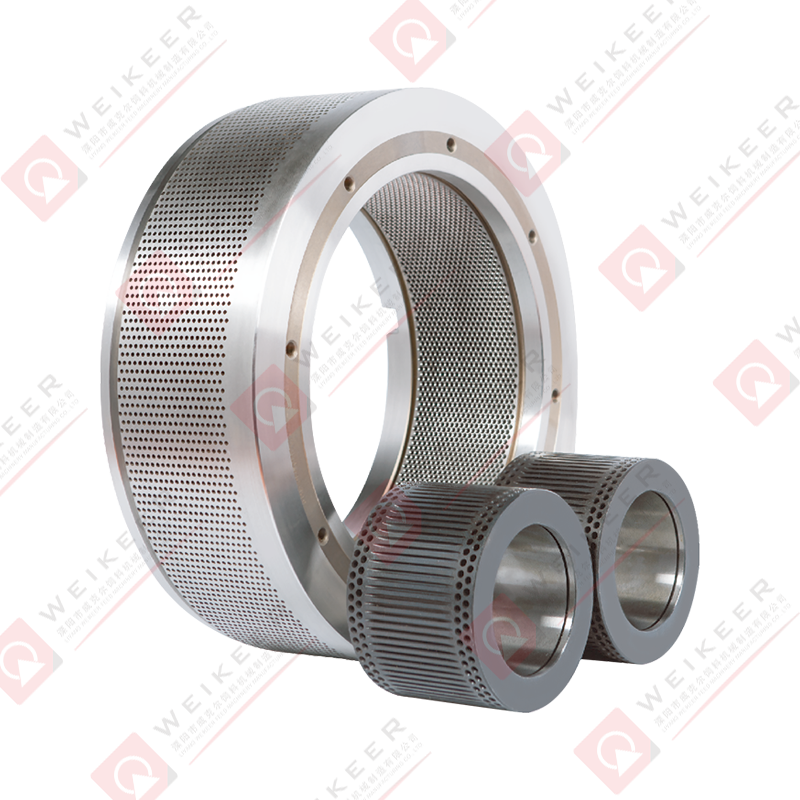
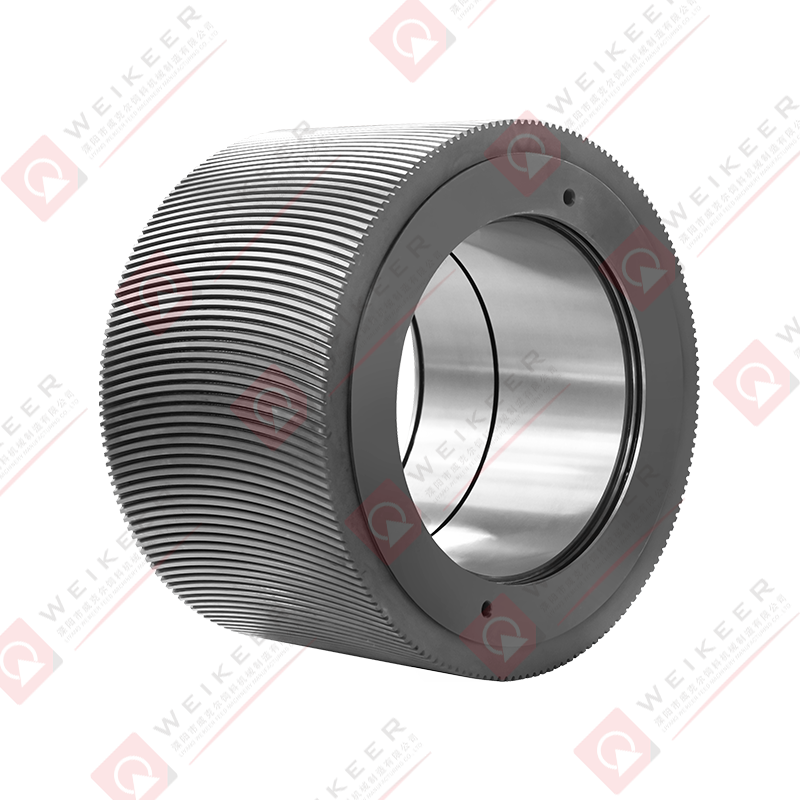
A die only performs as well as the rollers pushing mash through it. We build press rollers in 20CrMnTi alloy steel, GCr15 bearing steel and 100Cr6 spring steel, with face profiles that include closed corrugation and dimpled, curved corrugation, diagonal groove, corrugated close end, corrugated open end and dimpled. The right profile depends on how your mash grips: dense, oily aqua feed behaves nothing like a dry poultry mix. A roller that grips unevenly will bell-mouth a good die long before the die itself is worn.
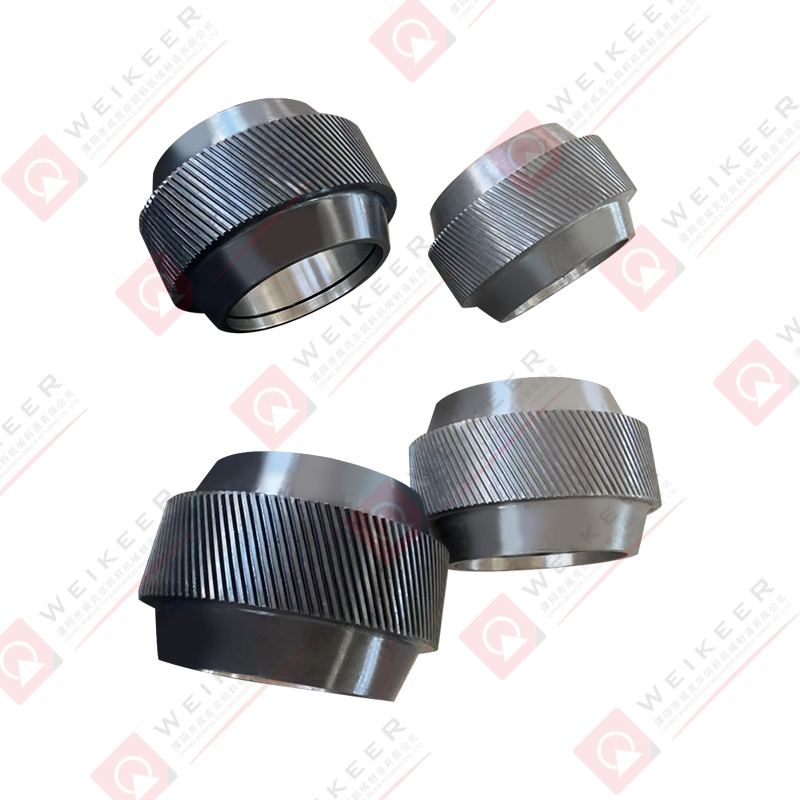 Diagonal Groove GCr15 Pellet RollerThe GCr15 roller with a diagonal groove design is a highly engineered component made from GCr15 bearing steel, known for its exceptional strength and durability. The d...View Product →
One Die Platform, Several Feed Segments
The screw type structure is not reserved for fish feed. The same mounting principle carries across livestock and poultry feed and biomass pellets, so a mill running both an aqua line and a poultry line can keep one die family and one maintenance routine. The hole pattern and compression ratio change; the way the die locks onto the press does not.
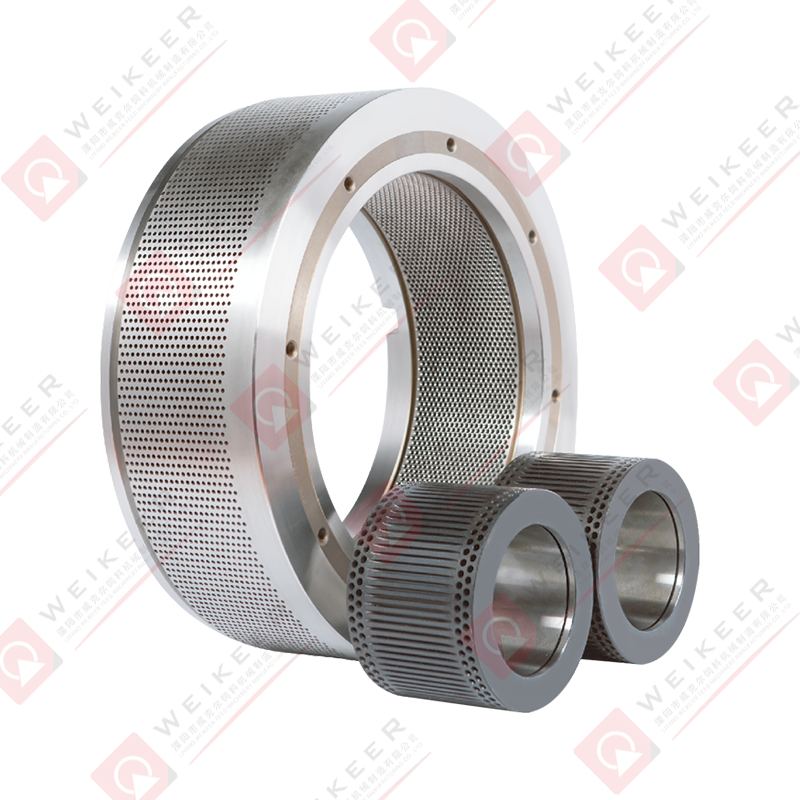 Livestock And Poultry Pellet Mill Screw Type Ring DieThe Screw Type Pellet Ring Die for livestock and poultry feed production is a critical component in pelletizing machines used to convert raw feed materials into unifor...View Product →
Will a Screw Type Die Fit Your Existing Pellet Mill?
Our dies and rollers are built to fit ZCME, CPM, IDAH, Bühler, Famsun, Andritz, Van Aarsen, Yeong Ming and Chiatung machines, along with many other models. To quote accurately, we need a few measurements rather than a brand name alone.
- Machine brand, model and nominal die size.
- Outer diameter, inner diameter and die thickness of the die you are replacing.
- The screw or bolt hole circle, including hole count and position.
- Target pellet diameter, formula type and expected output in tonnes per hour.
- A photo or drawing of the die holder if the existing die has been modified.
How to Compare Ring Die Factories Before You Order
- Check whether the factory specialises in dies and rollers, or treats them as a sideline to whole machines.
- Ask where the holes are drilled and where heat treatment happens. If both are outsourced, consistency is harder to guarantee.
- Ask for the hardness window the factory works to, and whether it is verified per die or per batch.
- Test one die through one full campaign and record tonnes per die, discharge temperature and pellet durability.
- Compare changeover time, not just purchase price. A cheaper die that costs an extra hour per change is rarely cheaper.
- Confirm export experience and packing: dies are heavy, easily distorted items.
Common Aqua Feed Die Problems and What They Usually Mean
Fault patterns aqua feed producers report most often, with the checks worth running before ordering a replacement die.
| Symptom |
Likely cause |
Check first |
| Pellets break up in water |
Compression ratio too low, or rollers not developing pressure |
Roller gap and roller face wear, then die compression ratio |
| Die blocks at start-up |
Mash too wet, holes not warmed through |
Start-up procedure, steam and moisture control |
| Discharge temperature climbs |
Compression too high, or too little open area |
Fat level in the mix and motor load against die capacity |
| Die lifts, screws loosen |
Uneven clamping, distorted holder, wrong torque sequence |
Flatness of die and holder, tightening sequence |
| Short die life, bell-mouthed holes |
Abrasives, wrong steel grade, roller slip |
Roller profile, hardness records, tonnes per die |
If your dies are spending more time off the press than on it, our note on the wear resistance of a screw type stainless steel die is worth reading before you place your next order.
Frequently Asked Questions
How long does a screw type aqua feed ring die last?
Life is measured in tonnes, not months. It depends on abrasives in the formula, roller condition, compression ratio and how carefully the die is warmed up after a change. A mill running a clean, well-conditioned mash will always see more tonnes than one running high shell content with worn rollers.
Can a screw type die replace an anchorear die?
Only if the die holder is designed for screw fixing. The two structures are not interchangeable on the same holder, so send us the holder measurements and we will confirm which family your press accepts.
Do you make dies for shrimp feed as well as fish feed?
Yes. Aqua feed is covered in both ring die families, and hole patterns are defined around the pellet sizes your line actually needs, from small shrimp pellets upward.
Do you supply press rollers with the die?
We supply both, and we recommend ordering them as a matched set. A new die run against worn rollers will underperform, and the blame usually lands on the die.
Choosing a screw type ring die is really a decision about how much of your production week you want back. Get the hole geometry, the steel and the roller pairing right, and the die stops being the part everyone talks about.
Send us your die measurements, formula type and target output through the quote form on our site, and our technical team will come back with a die specification you can hold us to. We answer enquiries in English, Russian, Spanish, Arabic and Chinese, and we are happy to work from a drawing or from the die you are replacing today.



 русский
 Español
 عربى
عربى 中文简体
中文简体