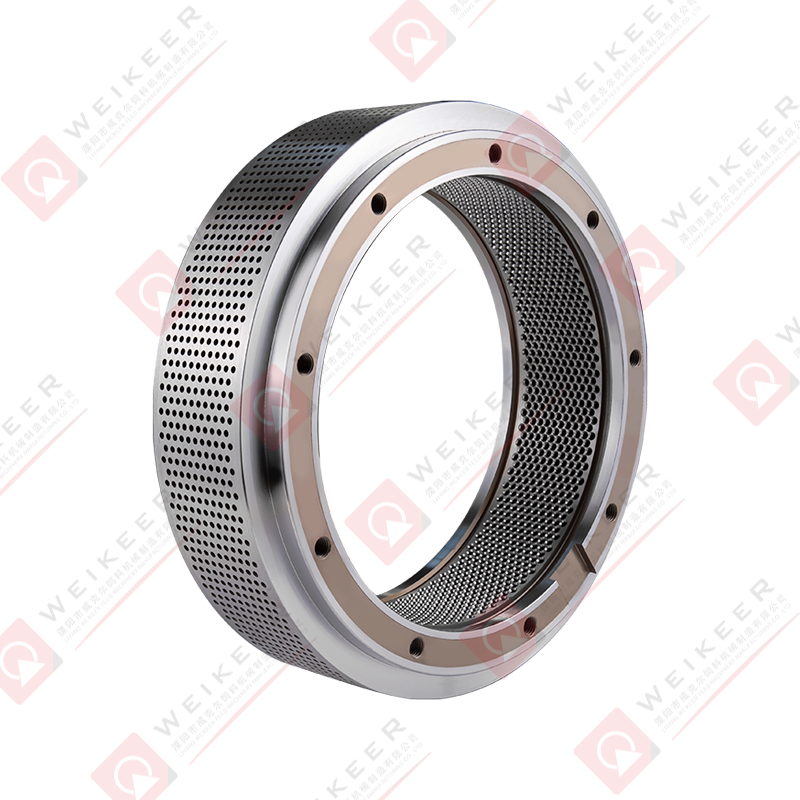
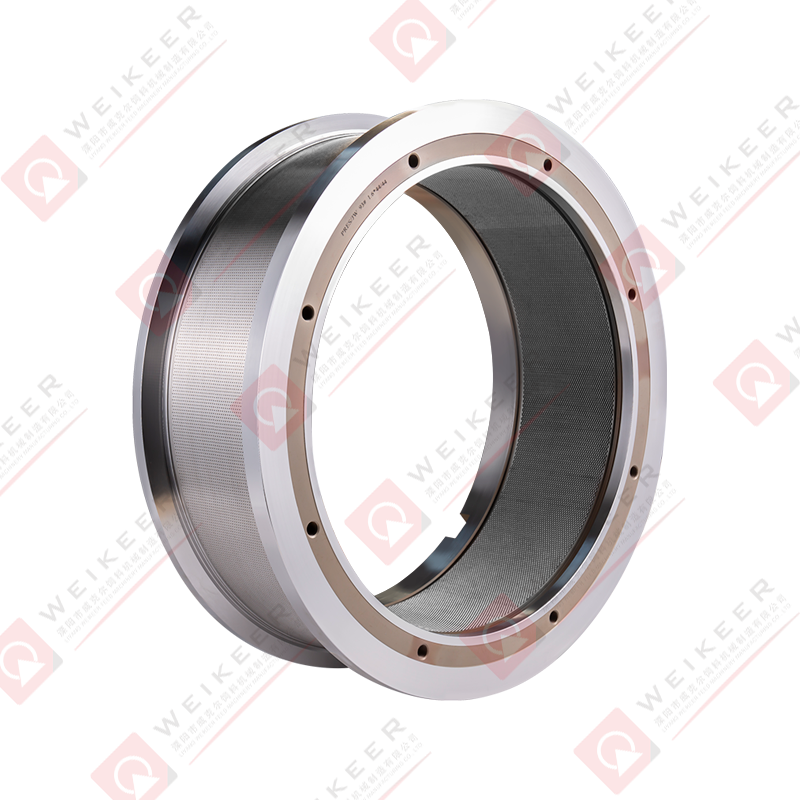
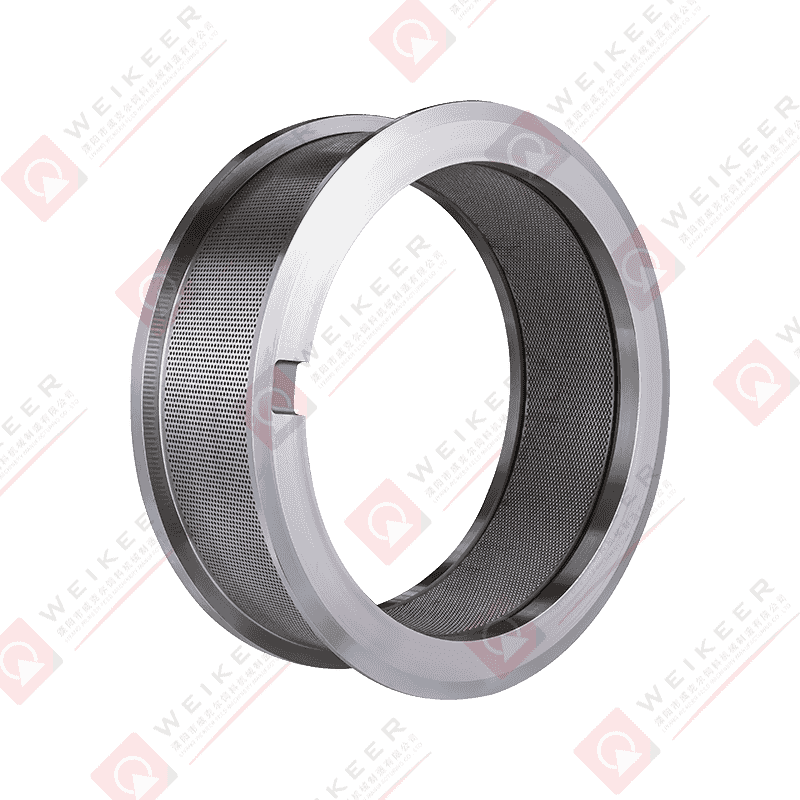
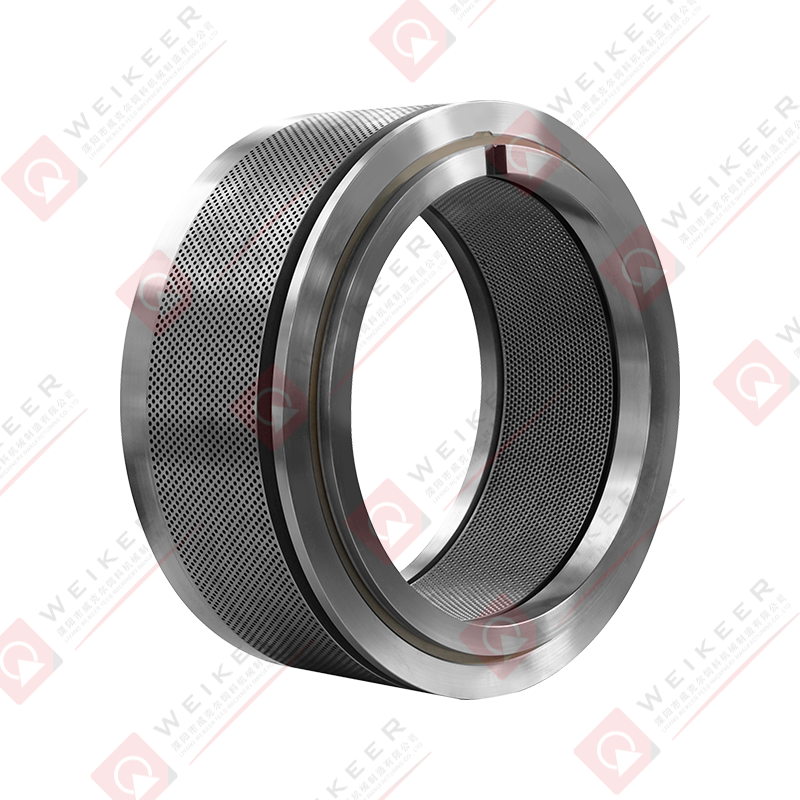
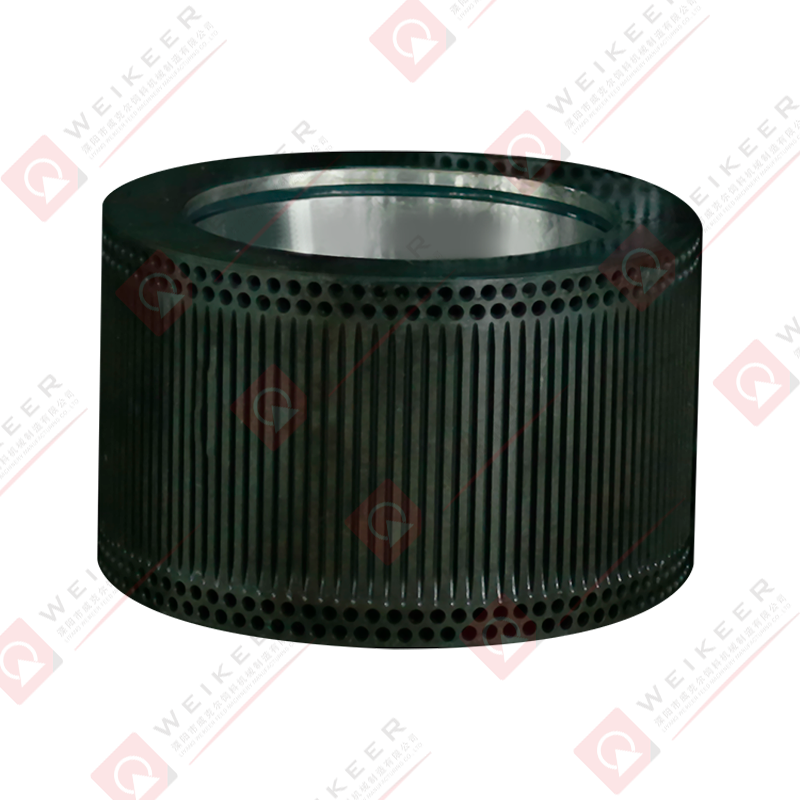
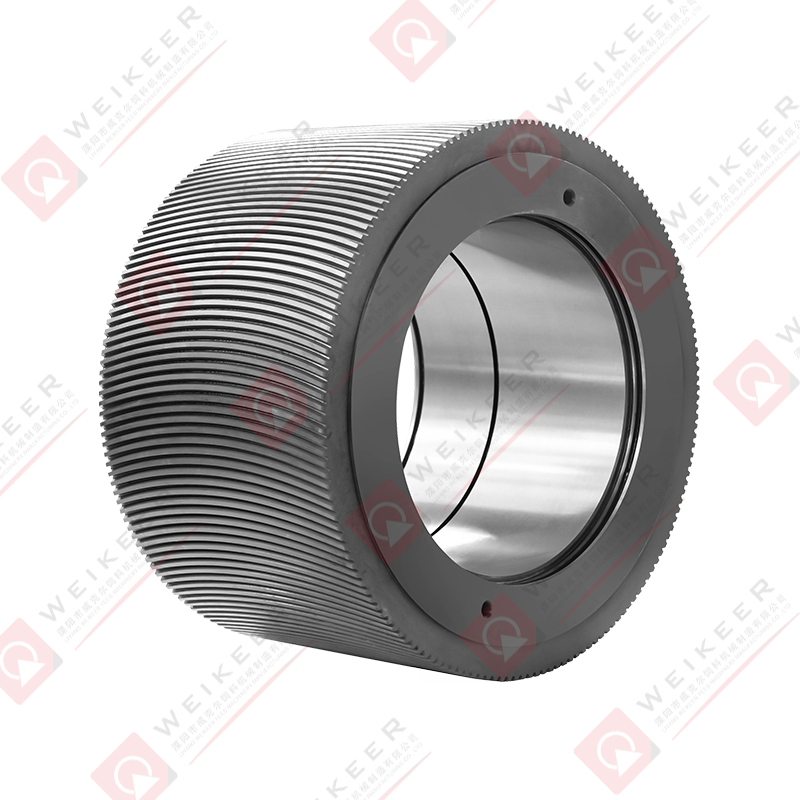
Every tonne of compound feed that leaves a mill has to squeeze through one small, heavily loaded ring of steel: the animal feed pellet die. It is a thick, hardened ring drilled with hundreds or thousands of tapered holes. Conditioned mash is pressed against its inner face by two or three rotating press rollers, forced through those holes under very high pressure, and cut into pellets on the outside of the ring. When the die suits the formulation, the press runs quietly, the amps stay steady and pellets leave the chamber firm and smooth. When it does not, you feel it inside a single shift: more fines, higher energy per tonne, more downtime.
We have been manufacturing dies, rollers and related wear parts since 1996, and this guide collects what that work has taught us about specifying, running and caring for an animal feed pellet die.
How an Animal Feed Pellet Die Works Inside the Press
Inside the pelleting chamber, the die is not simply a screen that lets material pass; it is the tool that does the forming. Rollers do not push feed through a die the way a piston works. The die turns, the rollers ride on a thin layer of mash, and friction between the material and the die wall builds the pressure that forces feed into the holes. That same friction generates much of the heat that cooks the mash into a durable pellet, which is why a worn or badly matched die changes both pellet quality and the thermal behaviour of the whole line.
Five numbers describe most of what a die will do:
- Hole diameter — the bore that sets pellet size and the resistance the mash meets.
- Effective thickness — the working depth of the hole along the material flow path.
- Compression ratio — effective thickness divided by hole diameter; higher ratios give harder pellets but lower throughput.
- Open area — the total hole cross-section; more open area means more capacity at the same pressure.
- Hole profile — inlet taper, straight section, relief and countersink, which together decide how easily feed enters and how cleanly the pellet releases.
Get these five right for your feed and the rest of the mill becomes far easier to tune.
Reading a Die Specification Like a Production Manager
Many mills buy a die by pellet diameter alone and then wonder why capacity or durability disappoints. In practice the compression ratio is usually the more important decision, because it controls how much work the press must do to form a pellet. The table below shows the combinations we see most often in animal feed production.
Typical hole diameter and compression ratio combinations for common animal feed pellet dies. Treat these figures as starting points; your formulation, moisture level and conditioning system decide the final specification.
| Hole diameter |
Effective thickness |
Compression ratio |
Typical application |
| 2.0 mm |
40 mm |
1:20 |
Fine aqua feed for fry and fingerlings |
| 3.0 mm |
45 mm |
1:15 |
Shrimp and small grow-out aqua feed |
| 4.0 mm |
48 mm |
1:12 |
Poultry grower and layer feed |
| 4.5 mm |
50 mm |
1:11 |
Pig grower and finisher feed |
| 6.0 mm |
60 mm |
1:10 |
Cattle and dairy maintenance feed |
A die that is too thin for a hard, abrasive formulation wears out quickly, while a die that is too thick for a soft, high-fat mash will choke the press and burn energy without improving the pellet. The right answer sits between those extremes, and it is worth testing before you commit a whole production campaign to one specification.
Anchorear and Screw Type Ring Dies: Which Suits Your Press?
Ring dies are fastened to the die holder in different ways, and the fixing method has to match the machine. In the anchorear design, the die is located and clamped by projecting ears or keys, which is common on presses where the die is changed from the front and the holder has matching seats. In the screw type design, the die is bolted or screwed to the holder around its circumference, which suits presses with a flanged or recessed mounting face.
The two designs are not interchangeable, so the first question to settle is always which mounting your machine accepts. Once that is clear, the choice of stainless steel grade, hole pattern and hardening treatment does the rest. We build both families, and for livestock and poultry compound feed a screw type stainless steel die offers a good balance of hardness, corrosion resistance and capacity.
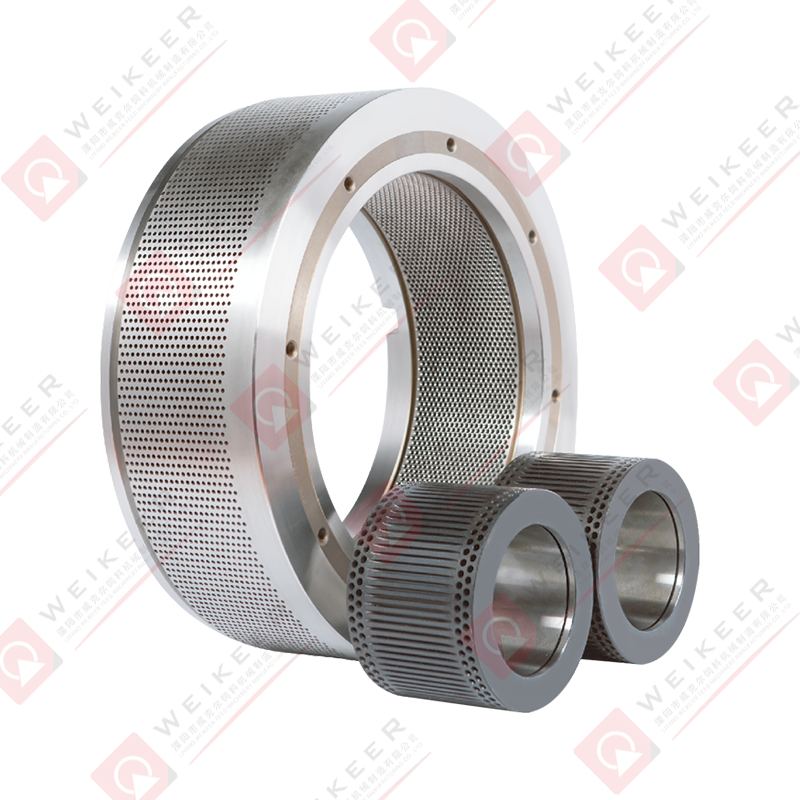 Livestock And Poultry Pellet Mill Screw Type Ring DieThe Screw Type Pellet Ring Die for livestock and poultry feed production is a critical component in pelletizing machines used to convert raw feed materials into unifor...View Product →
For producers who also run abrasion-heavy recipes, the same mounting principle applies; only the metallurgy and hole profile change.
Matching the Die to the Feed You Actually Make
Aquafeed is the most demanding category for any die, for one simple reason: the pellet has to stay intact in water. Shrimp and fish feeds are usually small in diameter, dense and often high in protein and fat, so the die needs a carefully judged compression ratio, smooth hole inlets and a corrosion-resistant stainless steel that can cope with damp, warm mash over long running hours.
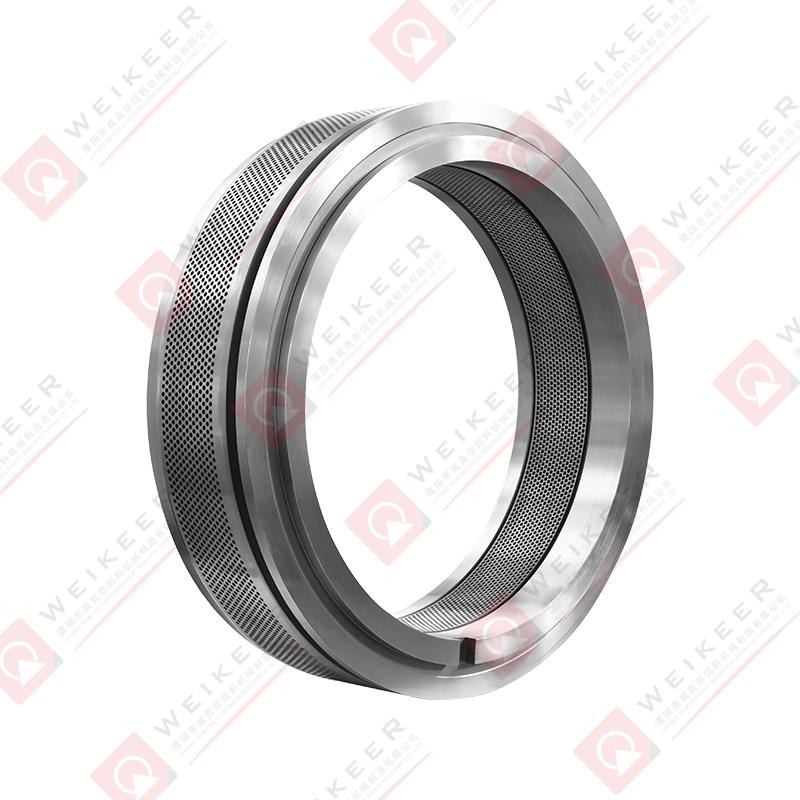 Aqua Feed Pellet Mill Anchorear Ring DieRing dies are used in pellet mills to produce feed pellets for various aquatic species, including fish, shrimp, and other marine life. Aquafeed ring dies must be made ...View Product →
Poultry and livestock feed allows more freedom. High-fibre diets, urea and mineral premixes are abrasive, so surface hardness and hole geometry matter more than pushing the compression ratio to an extreme. For dairy and beef feed, throughput usually wins over pellet durability, and a slightly lower ratio will keep the press running at a comfortable load all day.
Material, Hardness and Heat Treatment: Where Die Life Is Really Decided
A die is only as good as the steel beneath its surface and the heat treatment that follows. Stainless steels used for ring dies are selected for a combination of wear resistance, corrosion resistance and toughness, and the balance between those three properties is set during heat treatment rather than at the steel mill. Controlled austenitising, quenching and multi-stage tempering release internal stress and build the hard, tough working surface that survives thousands of tonnes of abrasive mash. We looked at one part of this mechanism in our note on factors affecting pellet feed hardness.
Hardness alone is not the goal. A die that is too hard becomes brittle and may crack under shock loads, while one that is too soft wears into a barrel shape within weeks and loses its compression ratio. Surface treatments such as nitriding deepen the hardened layer without making the core fragile, which is exactly what a ring die needs.
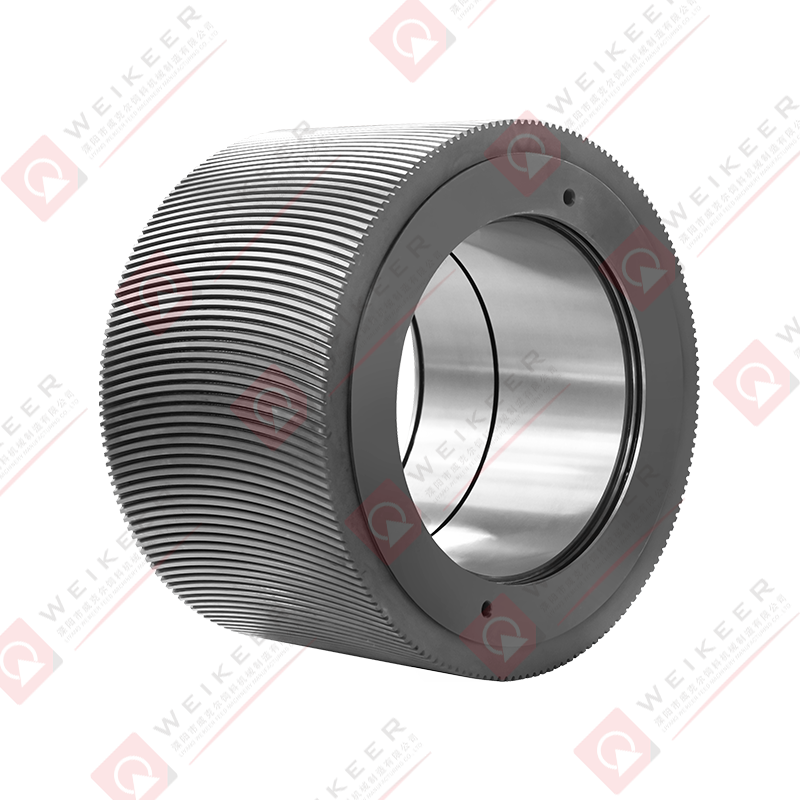
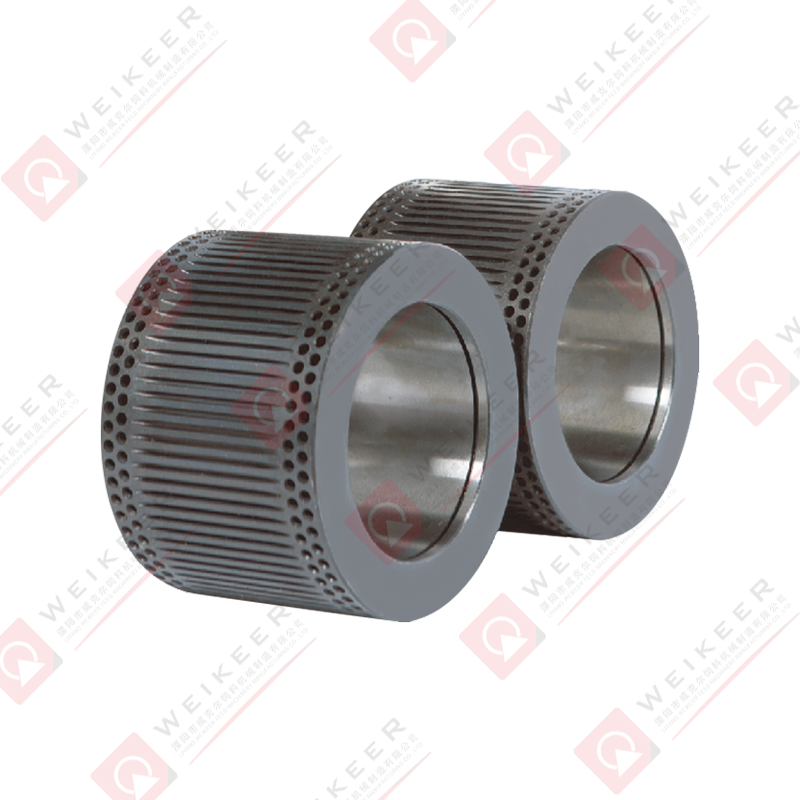
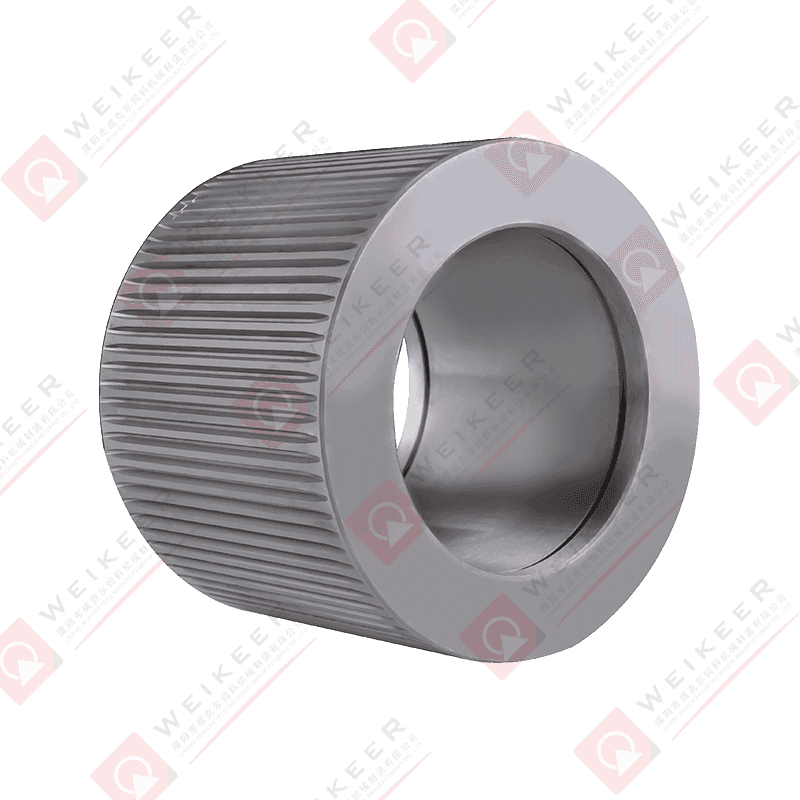
Press rollers work as a pair with the die and should always be assessed together with it. Roller bodies are commonly made from alloy steel such as 20CrMnTi, bearing steel such as GCr15, or spring steel such as 100Cr6, and the running surface can be corrugated, grooved or dimpled according to the feed being pressed. A matched roller surface keeps the mash layer even and protects the die from localised wear.
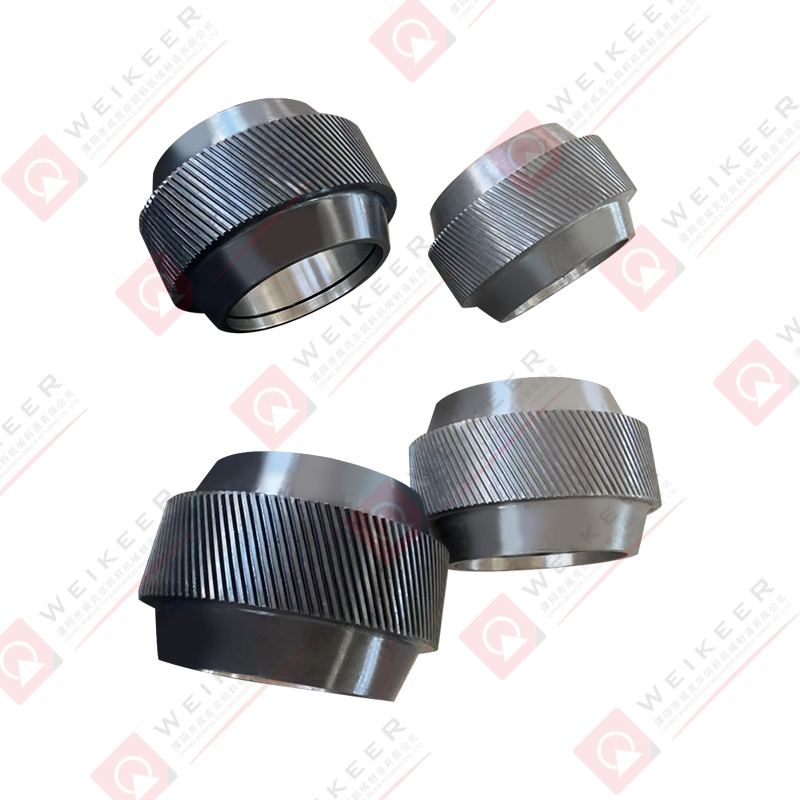 Diagonal Groove GCr15 Pellet RollerThe GCr15 roller with a diagonal groove design is a highly engineered component made from GCr15 bearing steel, known for its exceptional strength and durability. The d...View Product →
Signs Your Die Is Reaching the End of Its Working Life
Dies rarely fail without warning. The signals tend to appear in a predictable order:
- Amperage creeping up at the same feed rate, steam and formulation.
- Fines rising and the pellet surface turning rough, cracked or dusty.
- Capacity falling even though the die face looks clean and the rollers are set correctly.
- Hole diameter measured noticeably oversize compared with a new die.
- Visible cracking, chipping at the hole inlets or an uneven, glazed working face.
- Roller clearance that can no longer be set properly because the die surface is no longer true.
Any one of these on its own is worth logging. Two or three together usually mean the die has given you the tonnes it had.
Practical Ways to Get More Tonnes from Every Die
- Set roller-to-die clearance correctly, and check it after the first hour of running a new die.
- Run a new die in gently on an oily or high-fat recipe so the holes polish evenly before the load rises.
- Keep conditioning temperature and moisture consistent; sudden changes stress both die and rollers.
- Control particle size before pelleting and remove tramp metal with magnets ahead of the press.
- Match roller life to die life, so a worn roller surface does not shorten an otherwise healthy die.
- Record tonnes produced per die and per roller set, and compare them with the amperage trend.
None of these steps is expensive. Together they routinely add weeks of service life to a die.
What to Look For in a Die Manufacturing Partner
Because a die is a consumable, the supplier relationship matters almost as much as the steel. Look for a manufacturer that machines the holes and the mounting seats in-house, controls its own heat treatment, and can discuss compression ratio in terms of your formulation rather than in terms of what happens to be on the shelf.
Our own factory has been established since 1996 and stands near Tianmuhu in Liyang, Jiangsu, with a site of more than 13,000 square metres, of which over 7,000 square metres is production workshop space. The team includes 26 technical staff, and recent investment in CNC ring die machining equipment and dedicated heat treatment equipment supports the tolerances and hardness consistency that modern feed mills expect. Our process is inspired by European practice and aims at high quality, high efficiency and low energy consumption, and our dies and rollers are built to fit the widely used pellet mill makes found in feed plants today. You can see our factory and full product range here.
Frequently Asked Questions About Animal Feed Pellet Dies
How long does an animal feed pellet die last?
It depends far more on the feed than on the calendar. Abrasive, high-mineral rations can wear a die out in a few thousand tonnes, while a clean poultry or dairy recipe may run many times that. Track tonnes per die and watch the amperage trend; those two numbers tell you more than any published estimate.
Can I use a higher compression ratio to get harder pellets?
Usually not on its own. A higher ratio increases pellet durability, but it also raises the load on the press and can reduce capacity or cause choking. Durability is often better improved through conditioning, steam quality and formulation than through an unnecessarily thick die.
Should rollers be replaced at the same time as the die?
Not always, but they should be measured at the same time. A worn roller surface concentrates pressure and wears a new die unevenly, so if the roller surfaces are beyond their service limit, replacing them together with the die usually costs less than replacing the die twice.
Do you supply dies for imported pellet mills?
Yes. We manufacture ring dies and press rollers to suit the mainstream pellet mill makes used in feed plants, including anchorear and screw type mounting designs across aqua feed, livestock and poultry applications.
An animal feed pellet die is a small part of the mill and a large part of its economics. Specify it against the feed you run, look after it with disciplined roller settings and steady conditioning, and it will repay you in tonnes, in pellet quality and in energy saved.



 русский
 Español
 عربى
عربى 中文简体
中文简体