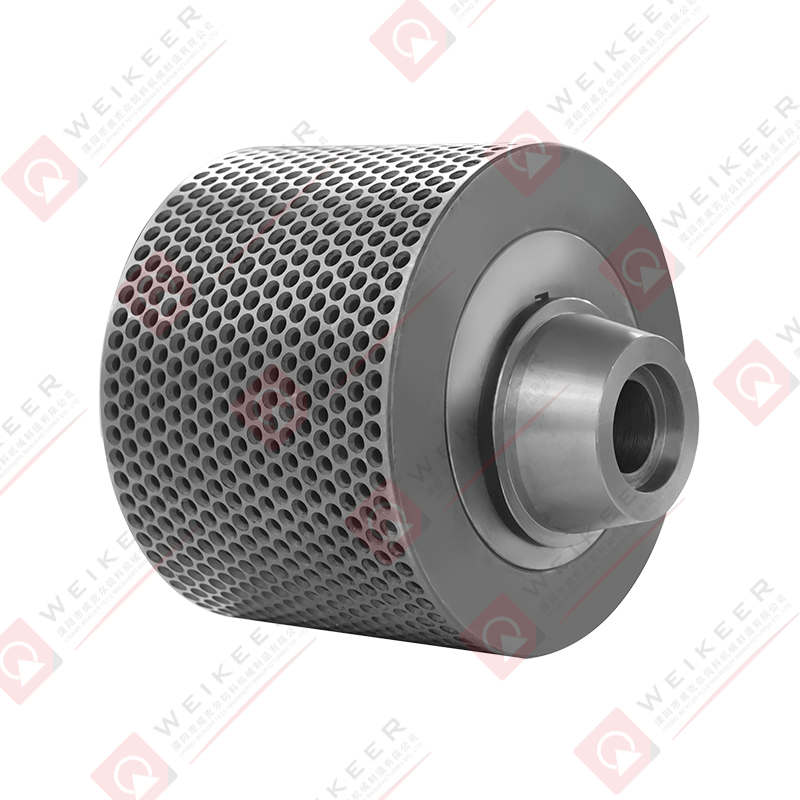
A roller shell rarely fails all at once. Output drifts down, the ammeter creeps up, pellets come out a little softer or a little dustier, and by the time someone walks over to the mill the shells are polished flat and the die is absorbing work it was never meant to do. We have been machining dies, rollers and roller shells in Liyang since 1996, and most of the GCr15 enquiries that reach us begin with a story very much like that one.
This article is for the people who have to specify the replacement: what bearing steel GCr15 actually contributes to a pellet mill roller, which shell profiles we cut from it, and how to order shells that suit the die and the machine already running on your floor.
What a Roller Shell Does Inside the Pellet Mill
A roller assembly is three parts doing three jobs. The shaft carries the load, the bearings let it spin, and the shell, the ring on the outside, is the only part that touches the feed. As the die turns, centrifugal force throws the rollers outward and drags material into the wedge between shell and die. Almost everything that happens in a pellet mill happens in that narrow gap.
That makes the shell a wear part by design: smaller and cheaper than the die, and meant to be sacrificed first. As shell diameter shrinks, the gap to the die opens, grip fades, and the mill starts slipping material instead of compressing it. Catching that early is the difference between a planned shell change and an unplanned die replacement. The signals we hear about most often are:
- Falling output at unchanged steam and feeder settings
- Higher motor load or a mill that sounds like it is working harder
- More fines, softer pellets, or a pellet surface that no longer shines
- A shell face that looks polished, ridged, or visibly stepped against a new shell
Why GCr15 Bearing Steel Is a Sensible Starting Point
GCr15 is the Chinese designation for the classic high-carbon chromium bearing steel, roughly 1% carbon and 1.5% chromium. You will meet the same family on European drawings as 100Cr6 and on American ones as 52100, so if your maintenance file uses any of those three names, it is broadly the same material.
What bearing steel brings to a roller shell is uniformity. It hardens through the section rather than only at the skin, typically landing in the high fifties to low sixties on the HRC scale after quenching and tempering, with fine and evenly distributed carbides. A shell like that wears slowly and, just as important, wears evenly, instead of developing a soft side that turns the roller oval and starts hammering the die. These are clean, low-inclusion grades, so there are fewer places for a fatigue crack to begin under the shock loads a mill delivers when a slug of wet material arrives. The bore also stays round after tempering, which keeps the shell sitting true on its shaft instead of rocking.
Honest limits: GCr15 is not stainless. On very wet, salty aqua feed, or on mineral premixes with aggressive components, corrosion can become the dominant wear mode and a stainless option usually serves better. On mills that regularly swallow tramp metal, a carburised alloy such as 20CrMnTi, with a hard case and a tough core, sometimes survives longer. We machine all three, which is why we are not going to tell you that bearing steel is always the answer.
Roller Shell Profiles We Machine in GCr15
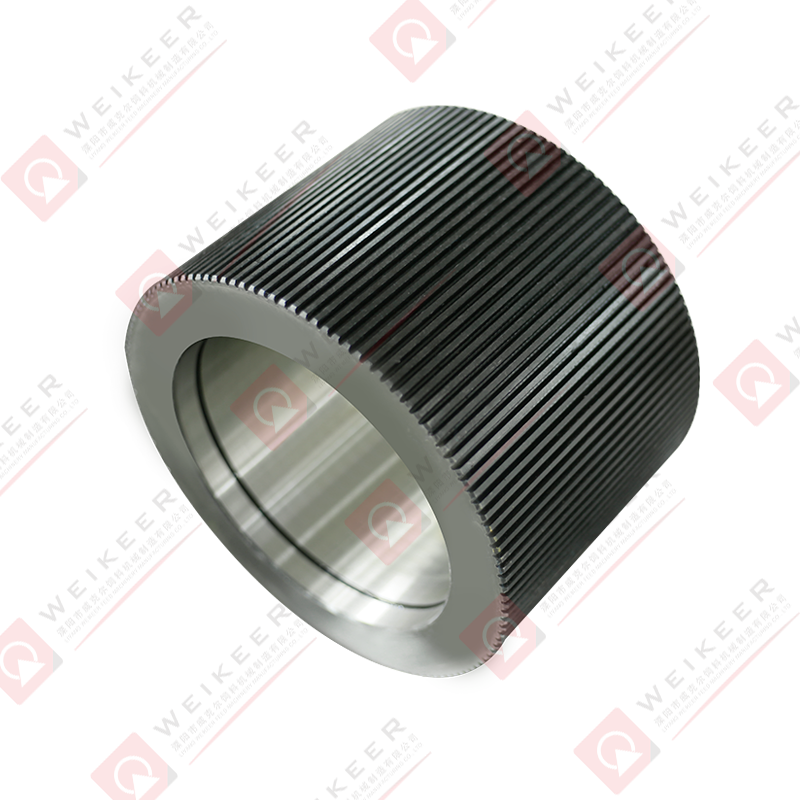
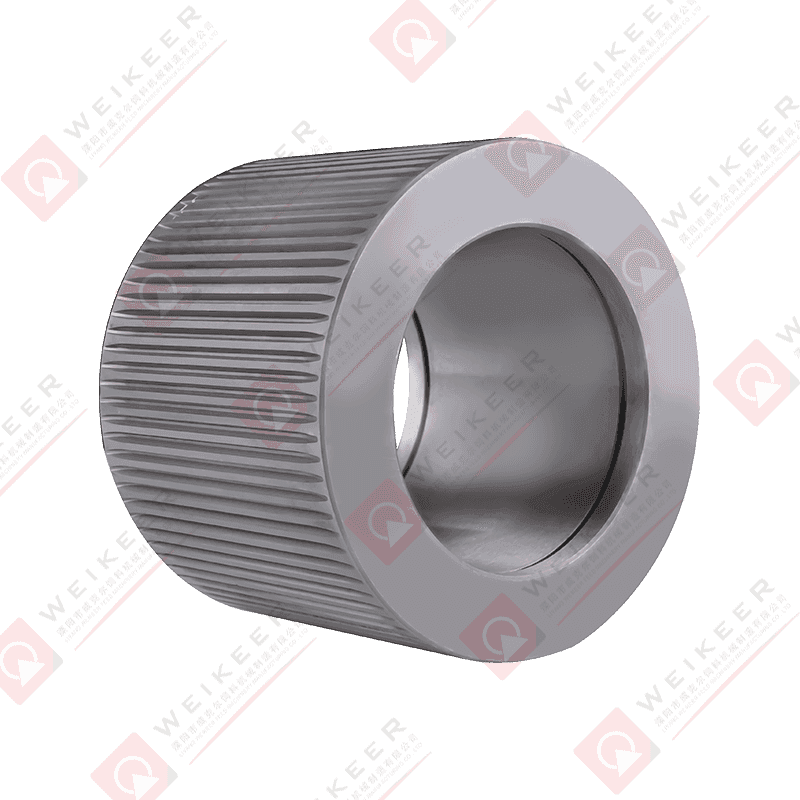
The grade gets a shell through the door; the profile decides how it behaves. We cut six standard surfaces in bearing steel, and the differences between them are not cosmetic.
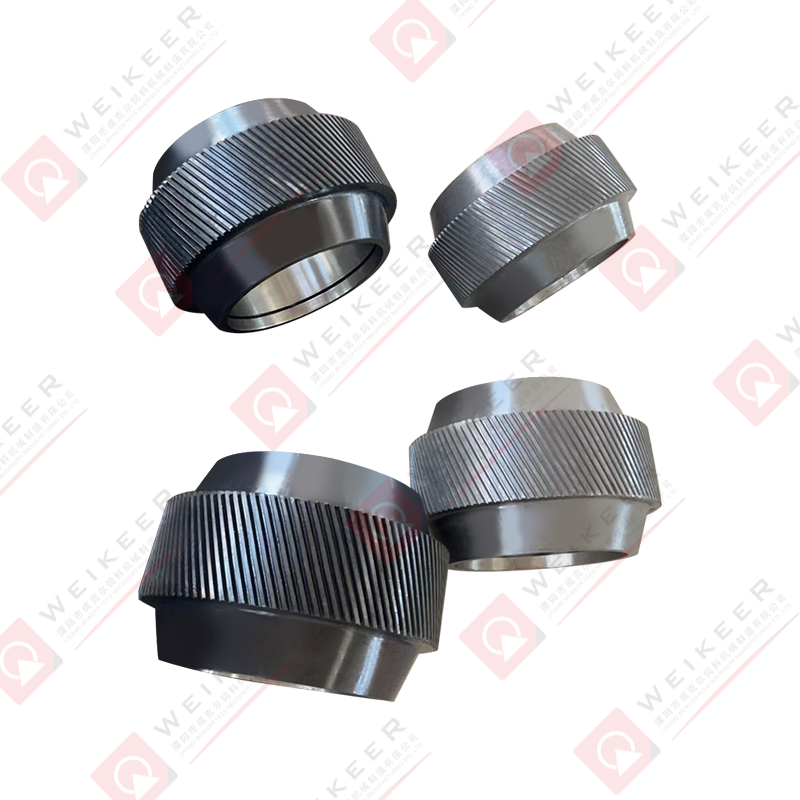 Diagonal Groove GCr15 Pellet Roller for Profile MatchingBearing-steel press roller with diagonal grooves for traction and grip; useful when comparing surface profiles against the die and formulation.View Product →
Profile choice is usually decided by what is being pelleted and how the mill is run; these notes are the way we talk it through with customers.
| Profile |
Where it earns its place |
What to watch |
| Corrugated, open end |
General feed and biomass; reliable grip on soft, bulky mash |
Material can escape at the ends on very wide shells |
| Corrugated, close end |
Similar duty with better end containment on high-capacity mills |
Needs a clean die face to keep grip even |
| Closed corrugation with dimples |
Dense, slippery or high-fat formulations |
Pockets must stay open; unstable moisture packs them |
| Curved corrugation |
Gentler grip for fragile or crumbly products |
Less aggressive bite than straight corrugation |
| Diagonal groove |
Even lateral spread of material across the face |
Wear pattern should be checked for taper |
| Dimpled |
Powdery or very slippery material that skates on plain surfaces |
Inspect for mash packing when moisture runs high |
Profile only makes sense next to the die. A deep, aggressive grip on a 1.5 mm aqua die behaves nothing like the same shell on a 6 mm livestock die. Send a worn sample and a formulation sheet and the profile conversation usually takes ten minutes, most of it spent avoiding a season of trial and error.
Matching Shells to Die, Material and Machine
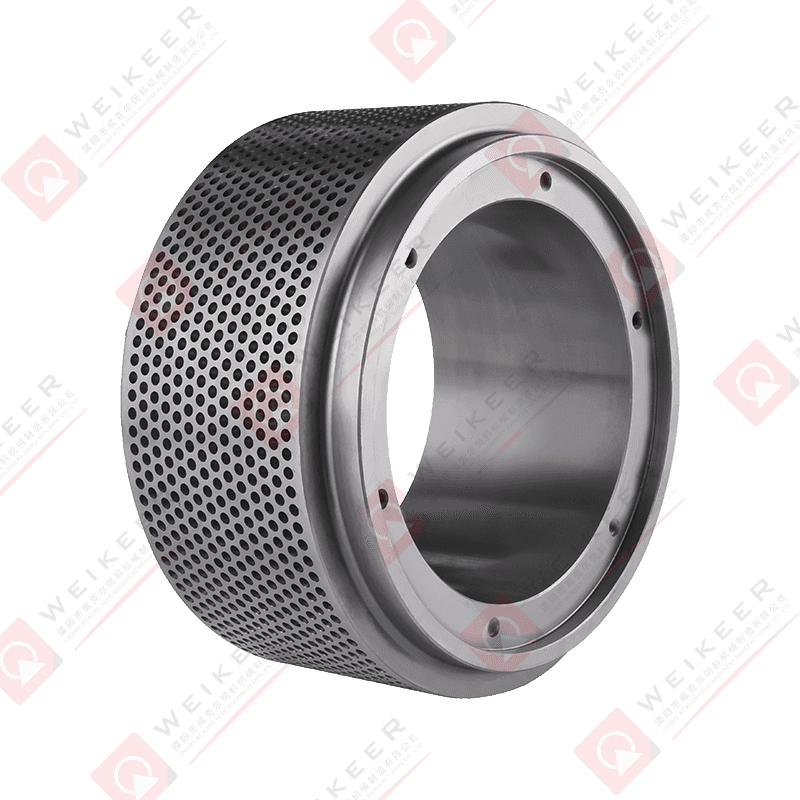
Surface is only one variable. A slippery, high-fat formulation that will not bite on a plain corrugation often responds to a dimpled shell, where the pockets carry material into the nip instead of letting it slide past.
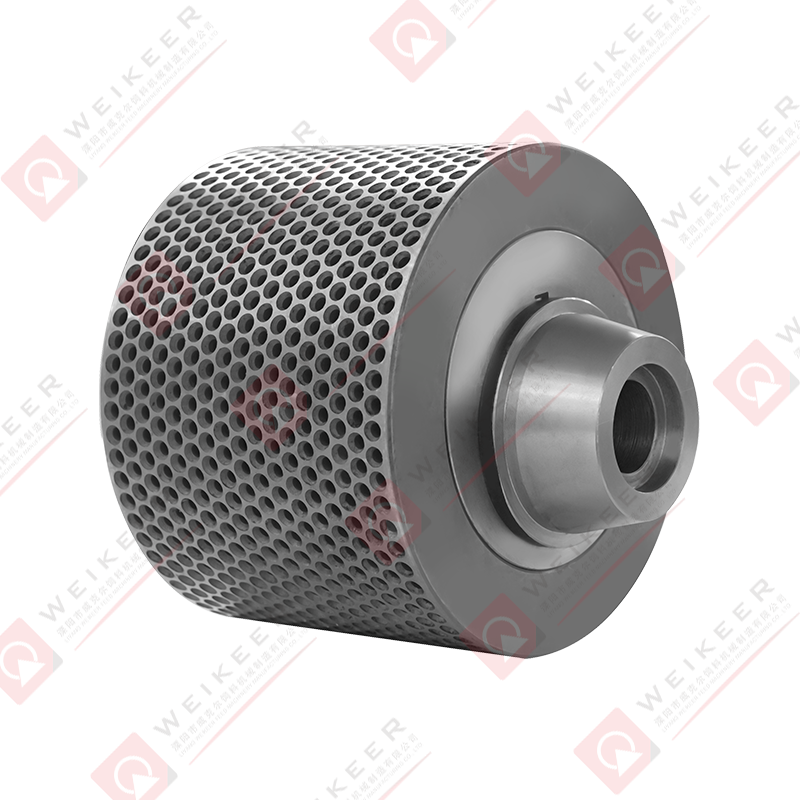 Dimpled Bearing Steel Pellet Roller with Closed EndsClosed-end dimpled press roller for formulations that need pockets to carry material into the nip; consider when surface grip and containment matter.View Product →
Fit is the other half of the job. Before quoting we normally ask for the following:
- Machine make and model, since we work from drawings or samples for the common pellet mill ranges
- Die outside diameter, inside diameter and working width
- Roller shaft diameter, shell width and fixing method (studs, bolts or retaining rings)
- The worn shell itself, when a drawing is not to hand
- What you are pelleting, your target tonnage and your steam conditions
Clearance between shell and die is the number most often guessed. Too tight and the shell runs metal to metal; too loose and material simply slides. Running at the correct working clearance, then re-checking after the first hours of running in, prevents most of the early failures we are asked about.
Heat Treatment and the Details That Decide Service Life
Two shells can carry the same grade stamp and behave completely differently. Hardness that is too low wears quickly; hardness that is too high, or badly tempered, cracks at the bore. A shell is a thin-walled ring, so the tempering step after quenching has to release the residual stress left behind by machining and hardening. That is what keeps the bore round and the profile from cracking in service.
In our plant, shells are machined on CNC equipment, heat treated on an HZQL furnace line, hardness checked on samples from each batch, and inspected for bore roundness, concentricity against the profile and profile depth against the drawing before packing. None of that is exotic. It is simply the difference between a shell that lasts its expected tonnage and one that fails in the first week.
Who You Are Actually Ordering From
Weikeer has been manufacturing in Liyang, near Tianmu Lake in Jiangsu, since 1996. The site covers roughly 13,000 m² with more than 7,000 m² of workshop, and the team includes 26 technicians. Ring dies, rollers and roller shells for feed, aqua feed, biomass, cat litter and fertiliser are what we make, produced to drawings or samples rather than squeezed into a fixed catalogue size. There is more about the machine shop, the heat treatment line and the people behind it on our about page.
Maintenance Habits That Pay for Themselves
- Check shell-to-die clearance at shift change and adjust as the shells wear
- Keep steam and moisture steady, since shells wear fastest when the mash swings
- Grease to the schedule, not beyond it, because surplus grease finds its way into places it should not be
- Look at the wear pattern on each shell; a taper or a flat spot points to an alignment problem
- Log tonnage per shell set, so a replacement decision rests on data rather than on sound
- Change shells as a matched set rather than one at a time, or the load will never be shared evenly
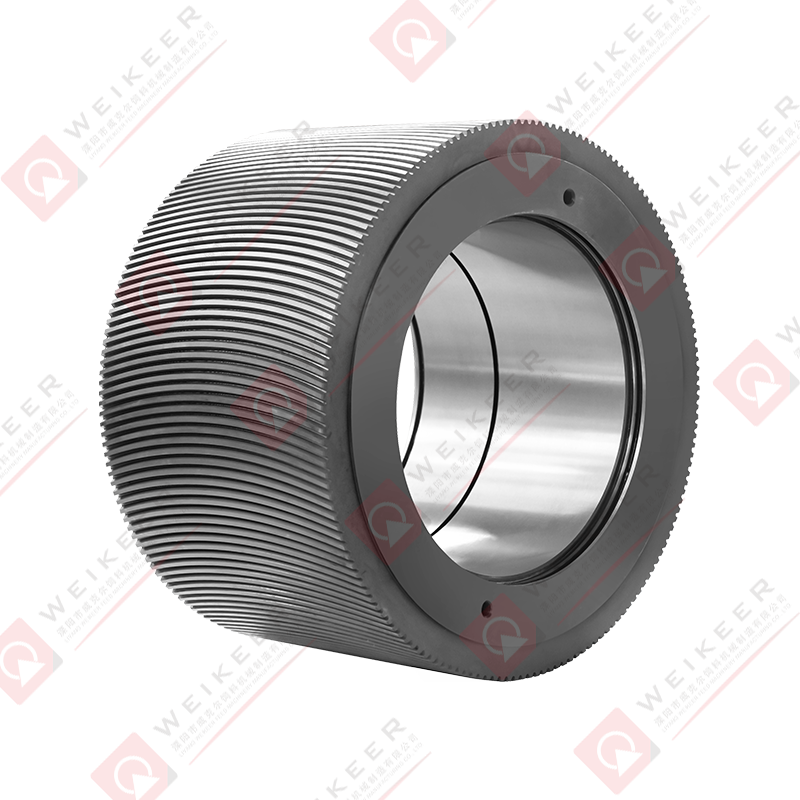
Most mills also keep one spare set on the shelf. A pair of corrugated open-end shells in GCr15 is the usual choice for general feed work, because it covers the widest range of formulations without fuss.
 Corrugated Open End GCr15 Pellet RollerBearing-steel press roller with corrugated surface and open-end design for easier assembly and maintenance; a practical general feed spare set.View Product →
Questions Buyers Ask Us
Is GCr15 the same as 100Cr6?
For practical purposes, yes. They are equivalent high-carbon chromium bearing steels from different standard systems, and the same drawing can usually be satisfied with either, provided the hardness and inspection requirements are respected.
How many tonnes should a shell last?
It varies widely with die compression, formulation abrasiveness, steam quality and clearance discipline. Customers report anything from a few thousand tonnes on abrasive biomass or mineral work to considerably more on clean livestock feed. Your own log is worth more than any benchmark we could quote.
Can you supply shells for imported pellet mills?
Yes. Most of our shell work starts from a drawing, a worn sample or the die dimensions, which is usually enough to match a machine that was built outside China.
Do you also make the dies?
We do, in stainless steel, for aqua feed, livestock and poultry feed, biomass, cat litter and complex fertiliser, which helps when shell and die need to be matched as a pair.
Getting a Shell That Fits the First Time
If you have a worn GCr15 shell in the workshop and a mill that needs to be back in production, send us the dimensions or the sample along with the formulation and target output. That is usually enough for us to recommend a grade, a profile and a working clearance with some confidence, and to tell you honestly if bearing steel is not the right choice for the duty. The fastest route is simply to get in touch with our technical team.



 русский
 Español
 عربى
 中文简体